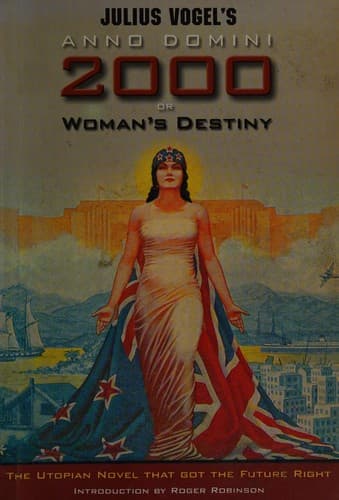
Anno Domini 2000; or, Woman's DestinyVogel, Julius, Sir
Science
Anno Domini 2000; or, Woman's Destiny
Vogel, Julius, Sir
Feminist fiction; New Zealand -- Fiction; Two thousand, A.D. -- Fiction; Utopian fiction; Utopias -- Fiction; Women -- Fiction
Five years previously all Europe was in a ferment. War was expected from
every quarter. It depended not on one, but on many questions. The
alliances were doubtful. Nothing seemed certain but that neutrality
would be impossible, and that the Continent would be divided into two or
more great camps. The final decision appeared to rest with Great
Britain. There an ominous disposition for war was displaying itself. The
inclination of the Sovereign and the Cabinet was supposed to be in that
direction. But the family of De Cardrosses throughout Europe was for
peace. The chief of the family was the head of the English house, and it
was decided he should interview the Prime Minister of England and
acquaint him with the views of this great financial group. His reception
was not flattering; but if he felt mortified, he did not show it. He
expressed himself deeply sensible of the honour done to him by his being
allowed to state his opinions; and with a reverential inclination he
bowed himself from the presence of the greatest statesman of his day,
the Right Honourable Randolph Stanley. That afternoon it was bruited
about that, in view of coming possibilities, the De Cardrosse family had
determined to realise securities all over Europe and send gold to
America. The next morning a disposition to sell was reported from every
direction, and five millions sterling of gold were collected for
despatch to New York. In twenty-four hours there was a panic throughout
Great Britain and Europe. The Bank of England asked for permission to
suspend specie payments, but could indicate no limit to which such a
permission should be set. It seemed as if Europe would be drained of
gold.
The great rivals of the De Cardrosses looked on and either could not or
would not interfere. A hurried Cabinet meeting was convened, and as a
result a conference by telephone was arranged between the Prime Minister
of Great Britain and the Ministers of the Great Powers of Europe.
Commencing by twos and threes, the conference developed into an
assemblage for conversational purposes of at least twenty of the chief
statesmen and diplomatists of the Old World. Rumour said that even
monarchs in two or three cases were present and inspired the telephonic
utterances of their Ministers. How the result was arrived at was known
best to those who took part in the conference, but peace and disarmament
were agreed on if certain contingencies involving the exercise of vast
power and the expenditure of enormous capital could be provided for. No
other conclusion could be arrived at, and one way or the other the
outcome had to be settled within twenty-four hours. The conference had
lasted from ten o'clock to four. At five o'clock by invitation Lord de
Cardrosse waited on the Prime Minister, who received him much more
cordially than before.
"You have caused me," he said, "to learn a great deal during the last
forty-eight hours."
"I could not presume to teach you anything. Events have spoken," was the
reply.
Public-domain text, read in full here on John Shaqi.
Reviews
Reviews
No reviews yet
Be the first to share your thoughts on this work.
Join the Discussion
Join the discussion
Sign in to leave a comment or review.
Sign InorCreate an account