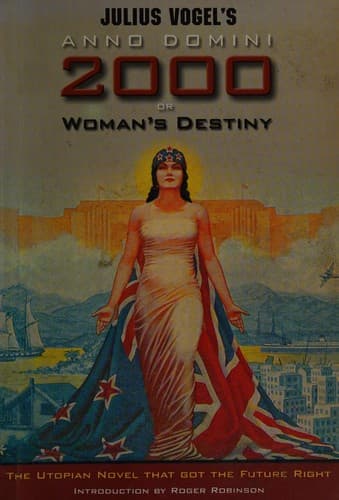
Anno Domini 2000; or, Woman's DestinyVogel, Julius, Sir
Science
Anno Domini 2000; or, Woman's Destiny
Vogel, Julius, Sir
Feminist fiction; New Zealand -- Fiction; Two thousand, A.D. -- Fiction; Utopian fiction; Utopias -- Fiction; Women -- Fiction
Strange to say, the inventor or discoverer was a young Jewish woman not
yet thirty years of age. From childhood she had taken an intense
interest in the question, and the terrible accident above recorded
seemed to spur her on to further exertion. She had a wonderful knowledge
of ancient languages, and she searched for information concerning
chemical secrets which she believed lost to the present day. She had a
notion that the atomic structure of substances was better known to
students in the early ages. It was said that the hint she acted on was
conveyed to her by some passage in a Chaldean inscription of great
antiquity. She neither admitted nor denied it. Perhaps the
susceptibilities of an intensely Eastern nature led her to welcome the
halo of romance cast over her discovery. Be that as it may, it is
certain she discovered a substance, or rather substances which, brought
into contact with each other, faithfully fulfilled all that the chemist
had ventured to suggest. Together with unwavering efficiency there was
perfect safety; and so much of the action depended on the structure, not
the composition, that the efforts of thousands of _savants_ failed to
discover the secret of the invention. What the substances were in
composition, and what they became after decomposition was easily
determined, but how to make them in a form that fulfilled the purpose
required defied every investigation.
The inventor did not patent her invention. After making an enormous
fortune from it, she sold it to the Government, who took over the
manufactory and its secrets; and whilst they sold it in quantity for
ordinary use, they jealously guarded against its accumulation in foreign
countries for possible warlike purposes. This invention, as much almost
as its vast naval and military forces, gave to the empire of Britain the
great power it possessed. The United States alone affected to underrate
that power. It was the habit of Americans to declare that they did not
believe in standing armies or fleets. If they wanted to fight, they
could afford to spend any amount of treasure; and they could do more in
the way of organising than any nation in the world. They were not going
to spend money on keeping themselves in readiness for what might never
happen. But we have not now to consider the aerial ships from their
warlike point of view.
It should be mentioned that the inventor of this new form of power was
the aunt of Colonel Laurient. She died nearly twenty years before this
history, and left to him, her favourite nephew, so much of her gigantic
fortune as the law permitted her to devise to one inheritor.
CHAPTER IX.
TOO STRANGE NOT TO BE TRUE.
Public-domain text, read in full here on John Shaqi.
Reviews
Reviews
No reviews yet
Be the first to share your thoughts on this work.
Elsewhere in the archive
Join the Discussion
Join the discussion
Sign in to leave a comment or review.
Sign InorCreate an account