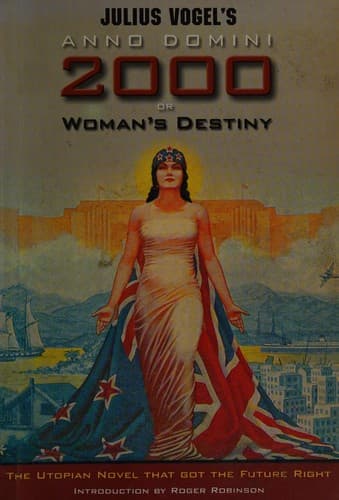
Anno Domini 2000; or, Woman's DestinyVogel, Julius, Sir
Science
Anno Domini 2000; or, Woman's Destiny
Vogel, Julius, Sir
Feminist fiction; New Zealand -- Fiction; Two thousand, A.D. -- Fiction; Utopian fiction; Utopias -- Fiction; Women -- Fiction
with the presents which were always showered upon them. They were too
useful to the traders of Stewart's Island not to receive consideration
at their hands. The seal-skins and the ivory obtained from Antarctica
were the finest in the world, and the latter was procured in immense
quantities from the ice-buried remains of animals long since extinct as
a living race.
Lady Taieri's friends spent a most pleasant two hours on the island.
Some recent arrivals from Antarctica were objects of great interest. A
young chief especially entertained them by his description of the
wonders of Antarctica and his unsophisticated admiration of the
novelties around him. He appeared to be particularly impressed with
Phoebe Buller. The poor girl blushed very much; and her companions were
highly amused when the interpreter told them that the young chief said
she would be very good-looking if her face was covered with hair, and
that he would be willing to take her back with him to Antarctica. Lady
Taieri proposed that they should all visit the island and be present at
the wedding. This sally was too much. Phoebe Buller retired to her
cabin on the cruiser, and was not seen again until the well-lighted
farms and residences on the beautiful Taieri plains, beneath the flying
vessel, reminded its occupants that they were close to their
destination.
During the next six days Lady Taieri gave a series of magnificent
entertainments. There were dances, dinner-parties, picnics, a visit to
the glacier region of Mount Cook, and finally a ball in Dunedin of
unsurpassed splendour. This was on the eve of the opening of the
river-works; and all the authorities of Wellington, including the
Governor and his Ministers, honoured the ball with their presence.
An account of the river-works will not be unacceptable. So long since as
1863 it was discovered that the river Molyneux, or Clutha as it was
sometimes called, contained over a great length rich gold deposits. More
or less considerable quantities of the precious metal were obtained from
time to time when the river was unusually low. But at no time was much
of the banks and parts adjacent thereto uncovered. Dredging was resorted
to, and a great deal of gold obtained; but it was pointed out that the
search in that manner was something like the proverbial exploration for
a needle in a haystack. A great scientist, Sir Julius Von Haast,
declared that during the glacial period the mountains adjacent to the
valley of the Molyneux were ground down by the action of glaciers from
an average height of several thousand feet. Every ounce of the
pulverised matter must have passed through the valley drained by the
river; and he made a calculation which showed that, if the stuff
averaged a grain to the ton, there must be in the interstices of the
river bed many thousands of tons of gold.
Public-domain text, read in full here on John Shaqi.
Reviews
Reviews
No reviews yet
Be the first to share your thoughts on this work.
Elsewhere in the archive
Join the Discussion
Join the discussion
Sign in to leave a comment or review.
Sign InorCreate an account