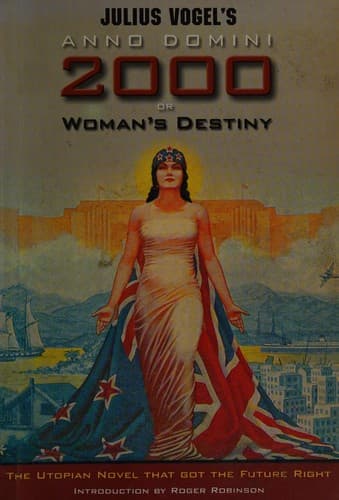
Anno Domini 2000; or, Woman's DestinyVogel, Julius, Sir
Science
Anno Domini 2000; or, Woman's Destiny
Vogel, Julius, Sir
Feminist fiction; New Zealand -- Fiction; Two thousand, A.D. -- Fiction; Utopian fiction; Utopias -- Fiction; Women -- Fiction
Nearly fifty years before the period of this history the grandfather of
Hilda and Maud Fitzherbert set himself seriously to unravel the problem.
His design was to deepen the bed of the Mataura river, running through
Southland, and to make an outlet to it from Lake Whakatip.
Simultaneously he proposed to close the outlet from the lake into the
Molyneux and, by the aid of other channels, cut at different parts of
the river to divert the tributary streams, to lay bare and clear from
water fully fifty miles of the river bed between Lake Whakatip and the
Dunstan. It was an enormous work. The cost alone of obtaining the
various riparian and residential rights absorbed over two millions
sterling. Twice, too, were the works on the point of completion, and
twice were they destroyed by floods and storms.
Mr. Fitzherbert had to take several partners, and his own enormous
fortune was nearly dissipated. He had lost his son and his son's wife
when his grandchildren, Hilda and Maud, were of tender age. After his
death the two girls found a letter from him in which he told them he had
settled on each of them three thousand pounds a year and left to them
jointly his house and garden near Dunedin, with the furniture, just as
they had always lived in it. Beyond this comparatively inconsiderable
bequest, he wrote, he had devoted everything to the completion of the
great work of his life. It was certain now that the river would be
uncovered; and if he was right in his expectations, they would become
enormously wealthy. If it should prove he was wrong, "which," he
continued, "I consider impossible, you will not think unkindly of the
old grandfather whose dearest hope it was to make you the richest girls
in the world." The time had come when these works, upon which so much
energy had been expended, and which had been fruitful of so many
disappointments, were to be finished; and a great deal of curiosity as
to the result was felt in every part of the Empire. Hilda and Maud
Fitzherbert had two and a half tenths each of the undertaking, and
Montreal and his younger brother had each one tenth, which they had
inherited, but it was understood that Montreal had parted with his own
share to Colonel Laurient; two tenths were reserved for division amongst
those people whose riparian and other rights Mr. Fitzherbert had
originally purchased; and of the remaining tenth one half was the
property of Sir Central Vincent Stout, Baronet, a young though very able
lawyer, the other half belonged to Lord Larnach, one of the wealthiest
private bankers in the Empire. There was by no means unanimity of
opinion concerning the result of the works. Some people held, they would
prove a total failure, and that the money spent on them had been wasted
by visionary enthusiasts; others thought, a moderate amount of gold
might be obtained; while very few shared the sanguine expectations which
had led old Fitzherbert to complacently spend the huge sums he had
devoted to his life's ideal.
Public-domain text, read in full here on John Shaqi.
Reviews
Reviews
No reviews yet
Be the first to share your thoughts on this work.
Elsewhere in the archive
Join the Discussion
Join the discussion
Sign in to leave a comment or review.
Sign InorCreate an account