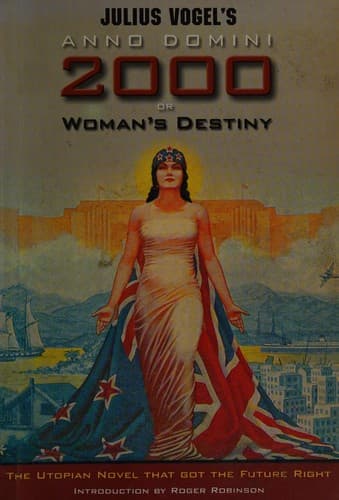
Anno Domini 2000; or, Woman's DestinyVogel, Julius, Sir
Science
Anno Domini 2000; or, Woman's Destiny
Vogel, Julius, Sir
Feminist fiction; New Zealand -- Fiction; Two thousand, A.D. -- Fiction; Utopian fiction; Utopias -- Fiction; Women -- Fiction
Immediately after the wedding Lord and Lady Montreal left in an
air-cruiser to pass their honeymoon in Canada, and the Duchess of New
Zealand at once proceeded to London, where she was rapturously received
by Mrs. Hardinge. She reached London in time to be present at its
greatest yearly fête, the Lord Mayor's Show, on the 9th November.
According to old chronicles, there was a time when these annual shows
were barbarous exhibitions of execrable taste, suitably accompanied with
scenes of coarse vulgarity. All this had long since changed. The annual
Lord Mayor's Show had become a real work of elaborated art. Either it
was made to represent some particular event, some connected thread of
history, or some classical author's works. For example, there had been a
close and accurate representation of Queen Victoria's Jubilee
procession, again a series of tableaux depicting the life of the
virtuous though unhappy Mary Queen of Scots, a portrayal of
Shakespeare's heroes and heroines, and a copy of the procession that
celebrated the establishment of local government in Ireland. The
present year was devoted to a representation of all the kings and queens
of England up to the proclamation of the Empire. It began with the
"British warrior queen," Boadicea, and ended with the grandfather of the
present Emperor. Each monarch was represented with his or her retinue in
the exact costumes of the respective periods. No expense was spared on
these shows. They were generally monumental works of research and
activity, and were in course of preparation for several years.
In many respects London still continued to be the greatest city of the
Empire. Its population was certainly the largest, and no other place
could compare with it in the possession of wealthy inhabitants. But
wealth was unequally distributed. Although there were more people than
elsewhere enjoying great riches, the aggregate possessions were not as
large in proportion to the population as in other cities, such as
Melbourne, Sydney, and Dublin. The Londoners were luxurious to the verge
of effeminacy. A door left open, a draught at a theatre, were
considered to seriously reflect on the moral character of the persons
responsible for the same. A servant summarily dismissed for neglecting
to close a door could not recover any arrears of wages due to him or
her. Said a great lady once to an Australian gentleman, "Are not these
easterly winds dreadful? I hope you have nothing of the kind in your
charming country."
"We have colder winds than those you have from the east," he replied.
"We have blasts direct from the South Pole, and we enjoy them. My lady,
we would not be what we are," drawing himself up, "if the extremes of
heat and cold were distasteful to us."
She looked at him with something of curiosity mixed with envy.
"You are right," she said. "It is a manly philosophy to endeavour to
enjoy that which cannot be remedied."
Public-domain text, read in full here on John Shaqi.
Reviews
Reviews
No reviews yet
Be the first to share your thoughts on this work.
Elsewhere in the archive
Join the Discussion
Join the discussion
Sign in to leave a comment or review.
Sign InorCreate an account