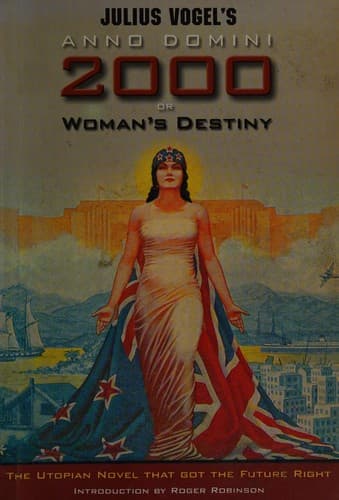
Anno Domini 2000; or, Woman's DestinyVogel, Julius, Sir
Science
Anno Domini 2000; or, Woman's Destiny
Vogel, Julius, Sir
Feminist fiction; New Zealand -- Fiction; Two thousand, A.D. -- Fiction; Utopian fiction; Utopias -- Fiction; Women -- Fiction
The use of coal and gas having long since been abandoned in favour of
heat and light from electricity, the buildings in London had lost their
begrimed appearance, and the old dense fogs had disappeared. A city of
magnificent buildings, almost a city of palaces, London might be termed.
Where there used to be rookeries for the poor there were now splendid
edifices of many stories, with constant self-acting elevators. It was
the same with regard to residence as with food and clothing. The
comforts of life were not denied to people of humble means.
Parliament was opened with much pomp and magnificence, and a mysterious
allusion, in the speech from the throne, to large fiscal changes
proposed, excited much attention. The Budget was delivered at an early
date amidst intense excitement, which turned into unrestrained delight
when its secrets were revealed. The Chancellor of the Exchequer, the
Right Honourable Gladstone Churchill, examined critically the state of
the finances, the enormous accumulations of the reserve funds all over
the dominions, and the continued increase of income from the main
sources of revenue. "The Government," he said, "are convinced the time
has come to make material reductions in the taxation. They propose that
the untaxable minimum of income shall be increased from five to six
hundred pounds, and the untaxable minimum of succession value from ten
to twelve thousand pounds, and that, instead of a fourth of the residue
in each case reverting to the State, a fifth shall be substituted." Then
he showed by figures and calculations that not only was the relief
justifiable, but that further relief might be expected in the course of
a few years. He only made one exception to the proposed reductions.
Incomes derived from foreign loans and the capital value of such loans
were still to be subject to the present taxation. Foreign loans, he
said, were mischievous in more than one respect. They armed foreign
nations, necessitating greater expense to the British Empire in
consequence. They also created hybrid subjects of the Empire, with
sympathies divided between their own country and foreign countries.
There was room for the expenditure of incalculable millions on important
works within the Empire, and those who preferred to place their means
abroad must contribute in greater proportion to the cost of government
at home. They had not, he declared, any prejudice against foreign
countries. It was better for them and for Britain that each country
should attend to its own interests and its own people. Probably no
Budget had been received with so much acclamation since that in which
the Chancellor of the Exchequer declared the policy of the Empire to be
one of severe protection to the industries of its vast dominions.
Public-domain text, read in full here on John Shaqi.
Reviews
Reviews
No reviews yet
Be the first to share your thoughts on this work.
Elsewhere in the archive
Join the Discussion
Join the discussion
Sign in to leave a comment or review.
Sign InorCreate an account