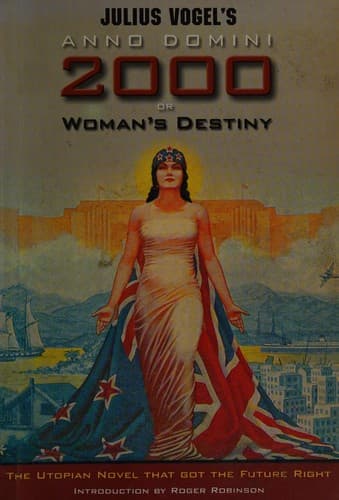
Anno Domini 2000; or, Woman's DestinyVogel, Julius, Sir
Science
Anno Domini 2000; or, Woman's Destiny
Vogel, Julius, Sir
Feminist fiction; New Zealand -- Fiction; Two thousand, A.D. -- Fiction; Utopian fiction; Utopias -- Fiction; Women -- Fiction
The President, however, was not anxious to resume her position. It was
to her headstrong action that the invasion of Canada was owing. The
President of the United States possesses more individual power in the
way of moving armies and declaring war than any other monarch. This has
always been the case. A warlike spirit is easily fostered in any nation.
Still the wise and prudent were aghast at the President's hasty action
on what seemed the slight provocation of the renewal of the immemorial
fisheries dispute. Of course public opinion could not gauge the sense of
wrong that the rejection by the Emperor of her daughter's hand had
occasioned in the mind of the President. Now that the episode was over,
and the empire of Britain had won a triumph which amply redeemed the
humiliation of centuries back, when the English colonies of America won
their independence by force of arms, public opinion was very bitter
against the President. The glorious 4th of July was virtually abolished.
How could they celebrate the independence and forget to commemorate the
retrieval by their old mother-country of all her power and prestige? No
wonder then that Mrs. Washington-Lawrence did not care to return to the
States!
"My dear," she said to her daughter in one of the luxurious cabins
assigned to them on the flagship, "do you think that I ought to send in
my resignation?"
"I cannot judge," replied the young lady. "You appear quite out of it.
Negotiations are said to be proceeding, but you are not consulted or
even informed of what is going on."
"If it were not for you," said the elder lady, "I would never again set
foot on the United States soil. Captain Hamilton" (alluding to the
captain of the vessel they were on, the _British Empire_) "says I ought
not to do so."
"I do not see that his advice matters," promptly answered the young
lady. "If Admiral Benedict had said so, I might have considered it more
important."
"I think more of the captain's opinion," said Mrs. Washington-Lawrence.
"Perhaps he thinks more of yours," retorted the unceremonious daughter.
"But what do you mean about returning for my sake?"
"My dear, you are very young, and cannot remain by yourself. Besides,
you will want to settle in the United States when you marry, to look
after the large property your father left you, and that will come to you
when you are twenty-one."
"I think, mother, you have interfered quite sufficiently about my
marrying. We should not be here now but for your anxiety to dispose of
me."
Mrs. Washington-Lawrence thought this very ungrateful, for her efforts
were not at the time at all repugnant to the ambitious young lady.
However, a quarrel was averted; and milder counsels prevailed. At length
the elder lady confessed, with many blushes, Captain Hamilton had
proposed to her, and that she would have accepted him but for the
thought of her daughter's probable dissatisfaction.
Public-domain text, read in full here on John Shaqi.
Reviews
Reviews
No reviews yet
Be the first to share your thoughts on this work.
Elsewhere in the archive
Join the Discussion
Join the discussion
Sign in to leave a comment or review.
Sign InorCreate an account