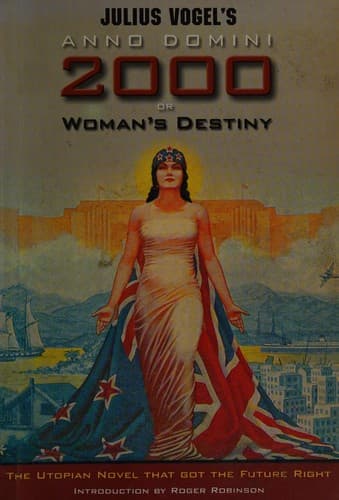
Anno Domini 2000; or, Woman's DestinyVogel, Julius, Sir
Science
Anno Domini 2000; or, Woman's Destiny
Vogel, Julius, Sir
Feminist fiction; New Zealand -- Fiction; Two thousand, A.D. -- Fiction; Utopian fiction; Utopias -- Fiction; Women -- Fiction
This aroused an answering confession from Miss Washington-Lawrence. The
admiral, it appeared, had twice proposed to her; and she had consented
to his obtaining the Emperor's permission, a condition considered
necessary under the peculiar circumstances.
The Emperor readily gave his consent. It was an answer to those of his
own subjects who had wished him to marry the New England girl with the
red hair, and opened the way to his announcing his marriage with Hilda.
The two weddings of mother and daughter took place amidst much rejoicing
throughout the whole squadron. The Emperor gave to each bride a
magnificent set of diamonds. Negotiations meanwhile with the United
States proceeded as to the terms on which the Emperor would consent to
peace, a month's truce having been declared in the meanwhile. Mrs.
Hardinge and Hilda met the chief ministers of the two powerful empires
in Europe, and satisfied them that the British Government would not ask
anything prejudicial to their interests.
The terms were finally arranged. The United States were to pay the
empire of Britain six hundred millions sterling and to salute the
British flag. The Childrosse family and Rorgon, Mose and Co. undertook
to find the money for the United States Government. The Emperor
consented to retire from New York in six months unless within that time
a plebiscite of that State and the New English States declared by a
majority of two to one the desire of the people to again become the
subjects of the British Empire, in which case New York would be
constituted the capital of the Dominion of Canada. To anticipate events,
it may at once be said that the majority in favour of reannexation was
over four to one, and that the union was celebrated with enormous
rejoicing. Most of the United States vessels were returned to her, and
the British Government, on behalf of the Empire, voluntarily
relinquished the money payment, in favour of its being handed to the
States seceding from the Republic to join the Canadian Dominion. This
provision was a wise one, for otherwise the new States of the Canadian
Dominion would have been less wealthy than those they joined.
CHAPTER XV.
CONCLUSION.
The Emperor went to Quebec for a week, and thence returned to London, in
the month of July. There he announced his intended marriage, and that it
would very soon take place. The ovations showered on the Emperor in
consequence of his successful operations in the United States defy
description. He was recognised as the first military genius of the day.
Many declared that he excelled all military heroes of the past, and that
a better-devised and more ably carried-into-effect military movement was
not to be found in the pages of history, ancient or modern.
Public-domain text, read in full here on John Shaqi.
Reviews
Reviews
No reviews yet
Be the first to share your thoughts on this work.
Elsewhere in the archive
Join the Discussion
Join the discussion
Sign in to leave a comment or review.
Sign InorCreate an account