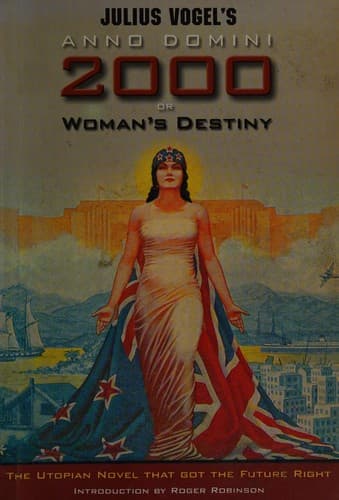
Anno Domini 2000; or, Woman's DestinyVogel, Julius, Sir
Science
Anno Domini 2000; or, Woman's Destiny
Vogel, Julius, Sir
Feminist fiction; New Zealand -- Fiction; Two thousand, A.D. -- Fiction; Utopian fiction; Utopias -- Fiction; Women -- Fiction
At such a time, had the marriage been really unpopular, much would have
been conceded to the desire to do honour to his military successes. But
the marriage was not unpopular in a personal sense. There was great
difference of opinion as to the wisdom of an emperor marrying a subject
instead of seeking a foreign alliance. On the one hand, difficulties of
court etiquette were alleged; on the other, it was contended that
Britain had nothing to gain from foreign marriage alliances, that she
was strong enough without them, and that they frequently were sources of
weakness rather than strength.
The Duchess of New Zealand sat alone in her study in the new mansion in
London of which she had just taken possession. It was magnificently
furnished and decorated, but she would soon cease to have a use for it.
She was to be married in a week, and the Empress of Britain would have
royal residences in all parts of her wide dominions. She intended to
make a present of her new house, with its contents, to Phoebe Buller on
her marriage with Colonel Garstairs. He won his promotion in the United
States war. She was writing a letter to her sister, Lady Montreal. A
slight noise attracted her attention. She looked up, and with dismay
beheld the face of Lord Reginald Paramatta. "How dare you thus intrude?"
she said, in an accent of strong indignation, though she could scarcely
restrain a feeling of pity, so ill and careworn did he look.
"Do not grudge me," he said, in deprecatory tones, "a few moments of
your presence. I am dying for the want of you."
"My lord," replied Hilda, "you should be sensible that nothing could be
more distasteful to me than such a visit after your past conduct."
"I do not deny your cause of complaint; but, Hilda--let me call you so
this once--remember it was all for love of you."
"I cannot remember anything of the kind. True love seeks the happiness
of the object it cherishes, not its misery."
"You once looked kindly on me."
"Lord Reginald, I never loved you, nor did I ever lead you to believe
so. A deep and true instinct told me from the first that I could not be
happy with you."
"You crush me with your cruel words," said Lord Reginald. "When I am
away from you, I persuade myself that I have not sufficiently pleaded my
cause; and then with irresistible force I long to see you."
Public-domain text, read in full here on John Shaqi.
Reviews
Reviews
No reviews yet
Be the first to share your thoughts on this work.
Elsewhere in the archive
Join the Discussion
Join the discussion
Sign in to leave a comment or review.
Sign InorCreate an account