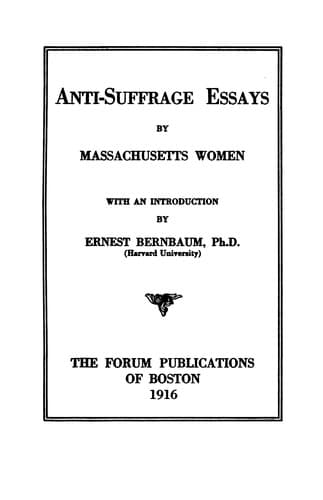
Women -- Massachusetts; Women -- Suffrage -- United States; Women's Anti-Suffrage Association of Massachusetts
Thus, instead of 8,000,000 women in industry who are alleged to "need
the ballot," we have only about 2,500,000 women of voting age employed
in industries that can reasonably be said to come within the category of
those properly subject to remedial labor legislation; and of these
women a very large percentage are aliens and would not be entitled to
use the ballot if woman suffrage were granted. By itself, of course,
this fact does not dispose of the argument that the industrial woman
needs the ballot, but it does reveal how comparatively few are the women
who could possibly try to improve their working conditions by means of
the vote, and how hopelessly outnumbered they would be if reduced to the
necessity of fighting for their rights at the ballot box.
The premise of the suffrage argument that the woman in industry needs
the ballot in order to get fair treatment is the assumption that she now
fails to get as fair treatment as is given the industrial man, and that
this is due to the fact that she has no vote. This arbitrary assumption
is without justification either in fact or reason. Every law placed upon
the statute-books of any state for the benefit of the working man is a
blanket law and covers men and women engaged in the same industry. All
the benefits that have accrued to the working man through legislation
are enjoyed equally by his sister in industry. In addition she has the
advantage of special protective laws which have been enacted simply
because she is a woman--because she is weaker physically than man and
because she is a potential mother and must be protected in the interest
of the race.
I am not arguing, of course, that the working woman has all the
protection she needs, but I am arguing that she is not unfairly treated
as compared with her industrial brother, who has the ballot, and that
whatever hardships she may now suffer are as likely to be removed
without woman suffrage as they are with it. If she is being unfairly
treated, I think it will be found that she is so treated in common with
all industrial workers--simply because she is a worker and not at all
because she is a woman.
And in taking this ground I am by no means forced to depend upon theory;
for, after all, the best answer to the dogma that the woman in industry
needs the ballot in order to obtain fair wages and fair working
conditions is the fact that in states where women have voted anywhere
from 4 to 46 years the laws for the working woman are no better than
they are in male suffrage states. Indeed, it is pretty generally agreed
that the states which have been first and most progressive in enacting
laws for the benefit of women and children in industry are states that
have refused to give women the vote.
Public-domain text, read in full here on John Shaqi.
Reviews
Reviews
No reviews yet
Be the first to share your thoughts on this work.
Join the Discussion
Join the discussion
Sign in to leave a comment or review.
Sign InorCreate an account