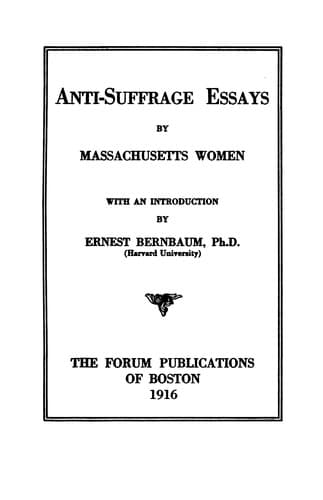
Women -- Massachusetts; Women -- Suffrage -- United States; Women's Anti-Suffrage Association of Massachusetts
Many women are now undertaking to engage in business, not as a
life-work, but as an incidental experience. It is true, however, that of
the many thousands of women so engaged, very, very few climb up the
ladder of success to the top rounds. It is the rare exception rather
than the rule for women to attain marked distinction, great wealth, or
fame in the business world. This is not caused by any unfairness of the
male sex, but by the nature, the physical and mental limitations, of the
members of the female sex. The trivialities of the afternoon tea are too
often present in the work of the wage-earning woman--too often she has
too slight a regard of her duty to return full value for the pecuniary
consideration she receives. The career of too many wage earning women is
now entirely haphazard, the result of necessity rather than
well-grounded choice. It is fair to assume that political matters would
receive the same degree of smattering knowledge and thought as is too
often received by the daily occupation into which many women drift.
It is much to be deplored that the trend of some modern young women is
more towards the commercial life in which her success is doubtful,
rather than toward the home-keeping, child-bearing, social, religious,
and philanthropic life for which she was physically and mentally
designed. These latter duties women faithfully and successfully perform
as their natural function, and through them they may rise to the
greatest distinction. Femininity should be cherished by the woman whom
circumstance or necessity drives into the wage-earning world, and she
can cherish it by retaining her hold on social, religious, and
charitable interests; but she cannot hope to do so if she attends
political meetings, serves on political committees, canvasses districts
for votes, watches at the polls, serves on juries, and debates political
questions or records and promises of political candidates. We have seen
the loss of femininity produced by the constant campaigning for
suffrage.
The instability of the female mind is beyond the comprehension of the
majority of men. The charm, the "sweet unreasonableness," the lack of
power of consecutive thought upon any intricate problem, which mark the
average woman are sometimes attractive and in personal or family
relations not without compensating advantages. In the business world,
however, these attributes are wholly detrimental. Business women might
possibly bring to political matters such training and experience as they
acquired, but to restrict the franchise to them would be to create a
class franchise. We must remember that suffrage would bring to the
electorate not merely the small number of business women, but the great
mass of women who have had little or no experience of life outside of
their homes.
Public-domain text, read in full here on John Shaqi.
Reviews
Reviews
No reviews yet
Be the first to share your thoughts on this work.
Join the Discussion
Join the discussion
Sign in to leave a comment or review.
Sign InorCreate an account