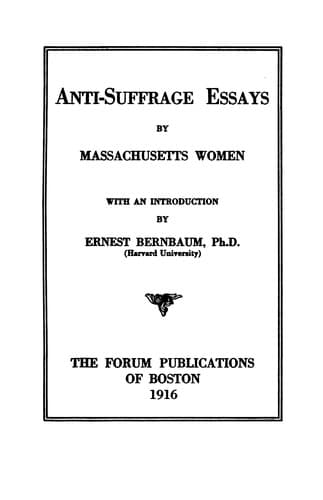
Women -- Massachusetts; Women -- Suffrage -- United States; Women's Anti-Suffrage Association of Massachusetts
The incongruity of suffragists attempting to pose as a peace party is
obvious to anyone with a memory and a sense of humor. Before the war
broke out, American suffrage leaders were applauding, feasting, and
subsidizing the British virago who instigated the setting on fire of 146
public buildings, churches, and houses, the explosion of 43 bombs, the
destruction of property valued at nearly two million dollars (not
including priceless works of arts), and many cases of personal assault.
In 1912 they justified the destruction of the Rokeby Venus; in 1914 they
professed horror at the bombardment of the Cathedral of Rheims. Is this
insincerity or hypocrisy, or mere aberration of mind?
The best time to work for peace is before war breaks out. The suffrage
organization was not conspicuous in seizing the many opportunities for
furthering the cause of peace before it was too late. In 1911 Mrs.
Frederick Nathan, a prominent suffragist, was asked to contribute to the
American Society for the Judicial Settlement of Disputes. She sent the
following characteristic refusal:
"Mrs. Frederick Nathan prefers to give her money to the Woman Suffrage
Association.... She has no faith in Courts of Law and Equity which deny
justice to women."
Was this boycotting of the peace movement condemned by the suffragists?
Not at all; Miss Alice Stone Blackwell, President of the Massachusetts
Suffrage Association, was glad to print the refusal in the official
organ of the National Woman Suffrage Association. Miss Blackwell, in
holding up this example to its members, scornfully declared that several
of the peace society were "prominent opponents of equal rights for
women." In those days, the suffragists were not hitching their wagon to
the quiet star of peace; it has been their constant practice to attach
themselves, for publicity's sake, to whatever movement is conspicuous on
the front pages of the newspapers--eugenics, or sex drama, or red-light
abatement, or what not--and to abandon that ephemeral interest whenever
it has ceased to serve the purpose of advertisement.
And so, when the war broke out, the boycotters of peace societies, and
colleagues of militants, made a rapid shift of costumes, and tried to
play roles in the Woman's Peace Party. So hurried was their change of
mental attitude that their thoughts on the subject were splendid
instances of snap judgment.
Public-domain text, read in full here on John Shaqi.
Reviews
Reviews
No reviews yet
Be the first to share your thoughts on this work.
Join the Discussion
Join the discussion
Sign in to leave a comment or review.
Sign InorCreate an account