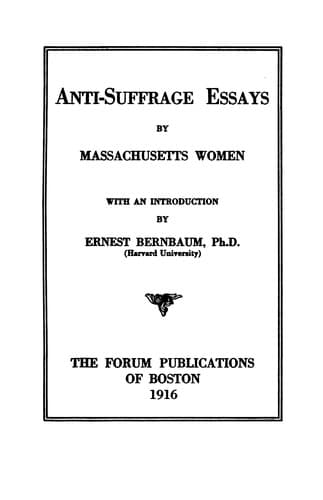
Women -- Massachusetts; Women -- Suffrage -- United States; Women's Anti-Suffrage Association of Massachusetts
What was meant by the "solidarity of women" is explained in Mrs. Pethick
Lawrence's words: "The interests of women, being fundamentally the same,
are so universal that no national distinctions can cut deeply into them,
as may possibly sometimes happen with the national distinctions between
men." Following that notion, Dr. Anna Howard Shaw issued an appeal to
the women's organizations in the belligerent countries, urging them to
put a stop to the war. The replies received showed that the expected
"international solidarity of women" was imaginary. The Association of
Austrian Women's Clubs, for example, replied that nobody understanding
the causes of the war, would have addressed such a request to them.
"Being women of those countries," ran this reply, "where our husbands,
brothers, and sons are fighting for the existence or non-existence of
our state, for our homes, for their wives and children, we cannot say:
'Do not fight'!" Similarly, the women's societies of France refused to
accept any invitations to peace palavers. In short, the real
"solidarity" was discovered to exist, not between women of different
nations, but between the women and the men of each nation.
The falsity of the other argument--that woman suffrage would tend
against militarism--was crushingly refuted when Dr. Ernest Bernbaum drew
attention to the recent history of militaristic policies in England and
Australia. In male suffrage England, Lord Roberts, despite his personal
popularity and strong arguments, was unable to get sufficient support
for his program of universal military service. In woman suffrage
Australia and New Zealand, on the other hand, the same line of arguments
was completely successful by 1911. There, boys from their twelfth year
are required to be enrolled for instruction in drill and the rudiments
of military science. The penalties for failure are severe, and public
opinion supports their enforcement; in New Zealand a boy was sent to
jail for refusing service, on ground of conscientious scruples; another
was fined and went into exile. The electorate was determined that New
Zealand and Australia should be nations in arms; indeed they were more
drastic than Germany, where many exemptions from military service on
various grounds are allowed. It is instructive to recall that when in
March, 1914, Winston Churchill, Lord of the Admiralty, advised Australia
that, in view of the Japanese alliance, it did not need to spend as much
money on warships, the Australian statesmen frankly intimating their
distrust in alliances, declared they would proceed with their expensive
naval program, which was supported by both political parties. I do not
say that what is termed "militarism" is a bad policy; I do say that when
the suffragists state that woman suffrage tends against militarism they
state what is diametrically opposed to the real truth of history. In
this case, as usual, they draw their principles not from observation of
Public-domain text, read in full here on John Shaqi.
Reviews
Reviews
No reviews yet
Be the first to share your thoughts on this work.
Join the Discussion
Join the discussion
Sign in to leave a comment or review.
Sign InorCreate an account