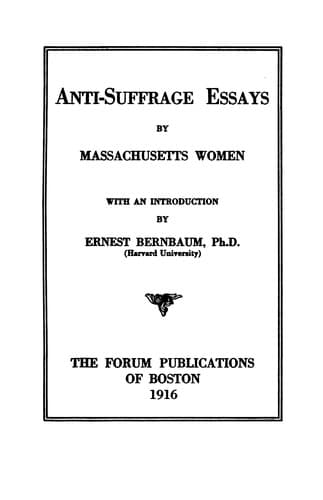
Women -- Massachusetts; Women -- Suffrage -- United States; Women's Anti-Suffrage Association of Massachusetts
As important a person as Dean Thomas, of Bryn Mawr College, in an appeal
for funds for the National American Woman Suffrage Association in
February, 1913, said:
"The ballot for women is the greatest of all the modern reforms. We urge
those who are today contributing to other causes to _withdraw_ or
_curtail_ their contributions until the ballot for woman is secured."
This seems to us anti-suffragists extremely narrow, as we know that
woman suffrage is not a reform, but an experiment in legislation only.
In a public resolution passed by the New England Women's Suffrage
Association at its forty-seventh annual meeting, the anti-suffragists
were referred to as using "pole-cat" tactics--why, we do not know. These
are only a few of the many evidences of the bitterness of feeling in
this political campaign.
The whole ideal of womanhood seems to be changing. The wife of an editor
of our most important New England magazine said to me:
"What use is it for you to oppose the suffrage movement, when it is only
the first step in this larger movement for the emancipation of women
that is sweeping over the world?" And I said: "Then we will do our best
to stop the first step," for I remembered the doctrines of the suffrage
leaders preached from their platforms. Mrs. Ida Husted Harper has said:
"There is not a single forward step of woman that has not been blocked
by the words 'wifehood' and 'motherhood'."
Dean Thomas, in an address to women at Mount Holyoke College, is quoted
in Mr. Martin's book, _The Unrest of Women_, as saying: "Women may have
spent half a lifetime in fitting themselves for a scholar's work, and
then may be asked to choose between it and marriage. No one can estimate
the number of women who remain unmarried in revolt before such a
horrible alternative."
Dr. Stanton Coit is reported as saying from a suffrage platform:
"Wifehood has all the characteristics of slavery--work without wage; no
specified hours; no right to change employers."
We find constantly the evil influence that this first step of suffrage
is having on the young women of our day; and, to me, the gist of the
whole matter seems summed up in a paragraph from a pamphlet written by
Mr. Joseph Pyle:
Public-domain text, read in full here on John Shaqi.
Reviews
Reviews
No reviews yet
Be the first to share your thoughts on this work.
Join the Discussion
Join the discussion
Sign in to leave a comment or review.
Sign InorCreate an account