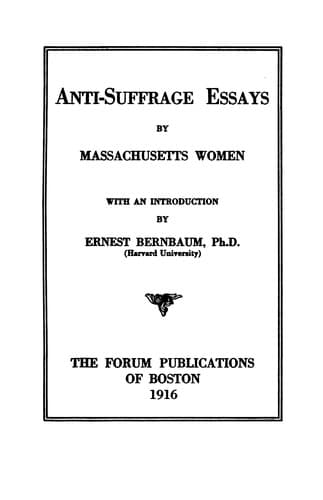
Women -- Massachusetts; Women -- Suffrage -- United States; Women's Anti-Suffrage Association of Massachusetts
The strongest motive for anti-suffrage action is the deepening dread of
woman suffrage as a menace to the home. The radical suffragists have
little use for the home, and the radical suffragists are young and
brilliant, and their following grows rapidly. It is they who are in the
public eye; whom the reporters interview; who, far more than the
conservatives, are really influencing the thought of the day. They claim
to be the consistent thinkers, reasoning from the common premise to
conclusions from which "older women" shrink. They welcome with
whole-hearted enthusiasm the theory of "economic independence."
This theory was first popularized by the _Woman's Journal_, in a notable
series of articles by Mrs. Charlotte Perkins Gilman, an associate
editor, which appeared weekly in 1904, and of which the central thought
was, "The woman should be in the home as much as the man is, no more."
She urged women to "come out of their little monogamous harems,"
promised that "when _all_ women are in industry, the conditions of
industry will be compelled to suit the conditions of maternity," and
predicted the time when "a man would no more think of having a woman
become his house servant than a woman would think of marrying her butler
and retaining him in that capacity." Mrs. Gilman summarized these ideas,
again, in a lecture in New York last year: "The home of the future is
one in which not one stroke of work shall be done except by professional
people who are paid by the hour."
This theory meets so well the anti-suffrage argument that the woman,
while spending most of her time within the home, cannot be expected to
attain outside it a degree of efficiency equal to that of the man, that
it naturally becomes part of the creed of the logical and consistent
suffragist. Miss Henrietta Rodman--a wife who, like Miss Fola La
Follette, retains her maiden name, because taking that of a husband
"dwarfs individuality"--gave to a reporter of the _Boston Herald_ last
year her opinion that "a house is as demoralizing a place to stay in all
day as a bed," and assured him that the ideal feminist apartment-house,
with its co-operative nursery on the top floor, had its plans actually
drawn, its site chosen. "Trained staffs are to relieve women of the four
primitive industries--care of houses, clothes, food and children." "By
real motherhood," said Miss Rodman, "I do not mean washing the baby's
clothes, preparing its food, watching over its sleep, nursing it through
its baby illnesses, nor, in later years, darning the children's
stockings, making or even mending their clothes, preparing their food or
supervising their education. All these things can be done better by
experts."
Public-domain text, read in full here on John Shaqi.
Reviews
Reviews
No reviews yet
Be the first to share your thoughts on this work.
Elsewhere in the archive
Join the Discussion
Join the discussion
Sign in to leave a comment or review.
Sign InorCreate an account