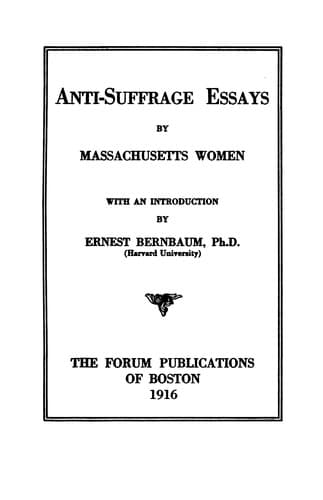
Women -- Massachusetts; Women -- Suffrage -- United States; Women's Anti-Suffrage Association of Massachusetts
No one can follow the utterances of this group of suffragists without
noting the constant slight cast on "domestic drudgery," and the
eagerness to prove other lines of activity better adapted to women.
"There is rising revolt among women," wrote Miss Edna Kenton, in _The
Century_ for November, 1913, "against the unspeakable dullness of
unvaried home life. It has been a long, deadly routine, a life-servitude
imposed on her for ages in a man-made world."
General Rosalie Jones, of "hiking fame," who is now breaking into the
automobile business, says: "There are idiot asylums in every state whose
inmates are expert at darning and mending. Any one of those idiots
sitting by the fireside could do the family mending, while the woman of
education, ingenuity and common sense, could utilize her faculties to
the betterment of her family and the country.... After suffrage is
granted, women will no longer be content to waste their brains in this
manner." Miss Inez Boissevain's "Ten Minutes-a-Day Housekeeping" is
well known, as is her declaration to the reporter that she "should go
crazy if she had to do housework one whole day." "Young children," she
admitted, "need their mother. But," she added hopefully, "the age at
which they can be left with others is much less than it was formerly
supposed to be." Mrs. Rheta Childe Dorr, Mrs. Pankhurst's closest
companion on her last United States tour, says: "Men are not yet used to
seeing their wives in the role of wage-earners. They'll have to get used
to it, that's all.... I don't say that every married woman must go to
work outside her home. I should commit suicide if I had to spend my life
doing housework, but some women probably like to do it. Let them do it
then. All I ask is that every woman, married or single, should be
allowed to choose the work in which she finds the most pleasure."
"To choose the work in which she finds the most pleasure"--there is the
real individualistic note, sounded so often by the radical suffragists.
It is struck still more clearly when to the reporter's question: "What
about the argument that the wife with a business career is apt to
deprive her husband of the joys of fatherhood?" Mrs. Dorr replies: "No
one but the individual woman herself has any right to decide whether or
not she shall have children. That is a question which she alone is
entitled to settle."
Public-domain text, read in full here on John Shaqi.
Reviews
Reviews
No reviews yet
Be the first to share your thoughts on this work.
Elsewhere in the archive
Join the Discussion
Join the discussion
Sign in to leave a comment or review.
Sign InorCreate an account