Chekhov, Anton Pavlovich, 1860-1904; Dostoyevsky, Fyodor, 1821-1881; Philosophy; Russian literature -- History and criticism
Produced by Marc D'Hooghe at Free Literature (Images
generously made available by the Internet Archive.)
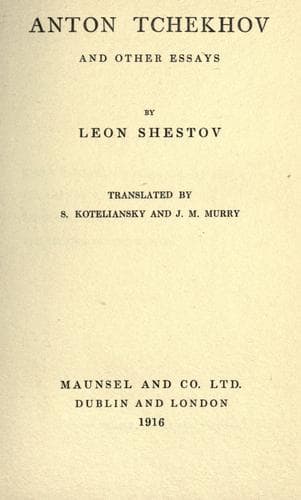
ANTON TCHEKHOV
AND OTHER ESSAIS
BY
LEON SHESTOV
TRANSLATED BY
S. KOTELIANSKY AND J. M. MURRY
MAUNSEL AND CO. LTD.
DUBLIN AND LONDON
1916
CONTENTS
ANTON TCHEKHOV (CREATION FROM THE VOID)
THE GIFT OF PROPHECY
PENULTIMATE WORDS
THE THEORY OF KNOWLEDGE
INTRODUCTION
It is not to be denied that Russian thought is chiefly manifested in
the great Russian novelists. Tolstoi, Dostoevsky, and Tchekhov made
explicit in their works conceptions of the world which yield nothing in
definiteness to the philosophic schemes of the great dogmatists of old,
and perhaps may be regarded as even superior to them in that by their
nature they emphasise a relation of which the professional philosopher
is too often careless--the intimate connection between philosophy and
life. They attacked fearlessly and with a high devotion of which we
English readers are slowly becoming sensible the fundamental problem of
all philosophy worthy the name. They were preoccupied with the answer
to the question: Is life worth living? And the great assumption which
they made, at least in the beginning of the quest, was that to live
life must mean to live it wholly. To live was not to pass by life on
the other side, not suppress the deep or even the dark passions of body
or soul, not to lull by some lying and narcotic phrase the urgent
questions of the mind, not to deny life. To them life was the sum of
all human potentialities. They accepted them all, loved them all, and
strove to find a place for them all in a pattern in which none should
be distorted. They failed, but not one of them fainted by the way,
and there was not one of them but with his latest breath bravely held
to his belief that there was a way and that the way might be found.
Tolstoi went out alone to die, yet more manifestly than he had lived,
a seeker after the secret; death overtook Dostoevsky in his supreme
attempt to wrest a hope for mankind out of the abyss of the imagined
future; and Tchekhov died when his most delicate fingers had been
finally eager in lighting _The Cherry Orchard_ with the tremulous glint
of laughing tears, which may perhaps be the ultimate secret of the
process which leaves us all bewildered and full of pity and wonder.
Public-domain text, read in full here on John Shaqi.
Reviews
Reviews
No reviews yet
Be the first to share your thoughts on this work.
Join the Discussion
Join the discussion
Sign in to leave a comment or review.
Sign InorCreate an account