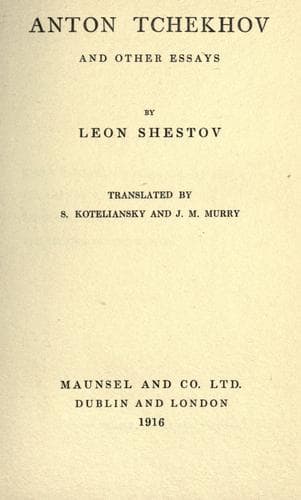
Chekhov, Anton Pavlovich, 1860-1904; Dostoyevsky, Fyodor, 1821-1881; Philosophy; Russian literature -- History and criticism
The same may be said of all the great representatives of philosophic
thought beginning with Plato and Aristotle, and ending with Hegel,
Schopenhauer and Nietzsche. Their works astonish by their power, depth,
boldness, beauty and originality of thought. While you read them it
seems that truth herself speaks with their lips. And what strong
measures of precaution did they take to prevent themselves from being
mistaken! They believed in nothing that men had grown accustomed to
believe. They methodically doubted everything, reexamined everything,
tens, hundreds of times. They gave their life to the truth not in
words, but in deed. And still the sum-total is the same in their case
as in Kant's: not one of them succeeded in inventing a system free from
internal contradictions.
Aristotle was already criticising Plato, and the sceptics criticised
both of them, and so on until in our day each new thinker struggles
with his predecessors, refutes their contradictions and errors,
although he knows that he is doomed to the same fate. The historians
of philosophy are at infinite pains to conceal the most glaring and
noticeable trait of philosophic creation, which is, at bottom, no
secret to any one. The uninitiated, and people generally who do not
like thinking, and therefore wish to be contemptuous of philosophy,
point to the lack of unity among philosophers as evidence that it is
not worth while to study philosophy. But they are both wrong. The
history of philosophy not only does not inspire us with the thought
of the continual evolution of an idea, but palpably convinces us of
the contrary, that among philosophers there is not, has not been, and
will never be, any aspiration towards unity. Neither will they find
in future a truth free from contradiction, for they do not seek the
truth in the sense in which the word is understood by the people and
by science; and, after all, contradictions do not frighten them, but
rather attract. Schopenhauer begins his criticism of Kant's philosophy
with the words of Voltaire: 'It is the privilege of genius to make
great mistakes with impunity.' I believe that the secret of the
philosophic genius lies here. He makes great, the greatest, mistakes,
and with impunity. Moreover his mistakes are put to his credit, for
the important matter is not his truths, or his judgments, but himself.
When you hear from Plato that the life we see is only a shadow, when
Spinoza, intoxicated by God, exalts the idea of necessity, when Kant
declares that reason dictates laws to Nature,--listening to them you
do not examine whether their assertions are true or not, you agree with
each of them, whatever he says, and only this question arises in your
soul: 'Who is he that speaketh as one having authority?'
Public-domain text, read in full here on John Shaqi.
Reviews
Reviews
No reviews yet
Be the first to share your thoughts on this work.
Elsewhere in the archive
Join the Discussion
Join the discussion
Sign in to leave a comment or review.
Sign InorCreate an account