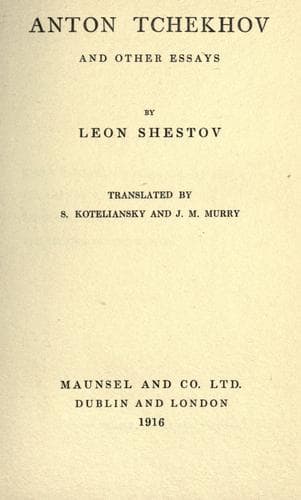
Chekhov, Anton Pavlovich, 1860-1904; Dostoyevsky, Fyodor, 1821-1881; Philosophy; Russian literature -- History and criticism
Later on, you will reject all their truths, with horror, perhaps with
indignation and disgust, even with utter indifference. You will not
consent to accept that our life is only a shadow of actual reality,
you will revolt against Spinoza's God, who cannot love, yet demands
love for himself, Kant's categorical imperative will seem to you a cold
monster,--but you will never forget Plato, or Spinoza, or Kant, and
will for ever keep your gratitude to them, who made you believe that
authority is given to mortals. Then you will understand that there are
no errors and no truths in philosophy; that errors and truths are only
for him above whom is set a superior authority, a law, a standard. But
philosophers themselves create laws and standards. This is what we are
taught by the history of philosophy; this is what is most difficult for
man to master and understand. I have already said that the historians
of philosophy draw quite a different moral from the study of the great
human creations.
_Science and Metaphysics_
In his autobiography Spencer confesses that he had really never
read Kant. He had had _The Critique of Pure Reason_ in his hands,
and had even read the beginning, the Transcendental Aesthetic, but
the beginning convinced him it was no use for him to read further.
Once a man had made the unconvincing admission which Kant had made,
by accepting the subjectivity of one form of perception, of space
and time, he could not be seriously taken into account. If he is
consistent, all his philosophy will be a system of absurdity and
nonsense; if he is inconsistent,--the less attention does he deserve.
Public-domain text, read in full here on John Shaqi.
Reviews
Reviews
No reviews yet
Be the first to share your thoughts on this work.
Elsewhere in the archive
Join the Discussion
Join the discussion
Sign in to leave a comment or review.
Sign InorCreate an account