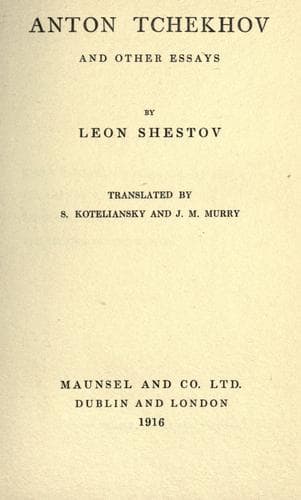
Chekhov, Anton Pavlovich, 1860-1904; Dostoyevsky, Fyodor, 1821-1881; Philosophy; Russian literature -- History and criticism
Herein the Kantians display an even greater indifference than Kant
himself: they are even proud of their indifference, they plume
themselves upon it as a high virtue. They assert that truth is not
_beyond_ synthetic judgments _a priori,_ but indeed _in_ them; and
that it is not the Creator who put blinkers upon us, but we ourselves
devised them, and that any attempt to remove them and look open-eyed
upon the world is evidence of perversity. If the old Serpent appeared
nowadays to seduce the modern Adam, he would retire discomfited.
Even Eve herself would be no use to him. The twentieth-century Eve
studies in a university and has quite sufficiently blunted her natural
curiosity. She can talk excellently well of the teleological point of
view and is quite as proof as man against temptation. I do not share
Kant's confidence that space and time are forms of our perception,
nor do I see a revelation in it. But if I had once accepted this
apocalyptic assertion, and could think that there was some truth in it,
I would not depart from it to positive science.
It is a pity that Spencer did not read _The Critique of Pure Reason_ to
the end. He would have convinced himself of an important truth: that a
philosopher has no need to take into consideration all the deductions
from his premisses. He need only have goodwill, and he can draw from
the most paradoxical and suspicious premisses conclusions which are
fully conformable to common-sense and the rules of decency. And since
Kant's will was as good as Spencer's, they would have agreed perfectly
in their deductions, though they were so far apart from each other in
their premisses.
_A Tacit Assumption_
Schopenhauer was the first philosopher to ask the value of life. And he
gave a definite answer: in life there is much more suffering than joy,
therefore life must be renounced. I must add that strictly speaking
he asked not only the value of life, but also the value of joy and
suffering. And to this question he gave an equally definite answer.
According to his teaching joy is always negative, suffering always
positive. Therefore by its essence joy cannot compensate for suffering.
Public-domain text, read in full here on John Shaqi.
Reviews
Reviews
No reviews yet
Be the first to share your thoughts on this work.
Elsewhere in the archive
Join the Discussion
Join the discussion
Sign in to leave a comment or review.
Sign InorCreate an account