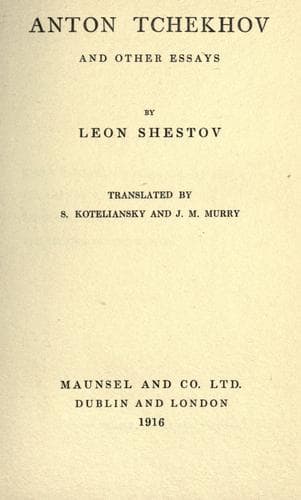
Chekhov, Anton Pavlovich, 1860-1904; Dostoyevsky, Fyodor, 1821-1881; Philosophy; Russian literature -- History and criticism
And it must be sought by methods quite different from those by which
it has been sought hitherto. To some extent Kant attempted to describe
how he represented to himself the meaning hidden beneath the words:
'Space and time are subjective forms of perception.' He even gave an
object-lesson, saying that perhaps there are beings who perceive the
world otherwise than under the forms of space and time: which means
that for such beings there is no change. All that we perceive by a
succession of changes, they perceive at once. To them Julius Caesar
is still alive, though he is dead; to them the twenty-fifth century
A.D., which none of us will live to see, and the twenty-fifth century
B.C., which we reconstruct with such difficulty from the fragmentary
traces of the past which have accidentally been preserved to us, the
remote North Pole, and even the stars which we cannot see through the
telescope--all are as accessible to them as to us the events which
are taking place before our eyes. Nevertheless Kant, in spite of all
temptation to acquire the knowledge to which such beings have access,
notwithstanding his profound conviction of the truth of his discovery,
did nothing to dispel the charm of forms of perception and categories
of the reason, or to tear the blinkers from his eyes and see all the
depth of the mysterious reality hitherto hidden from us. He does not
even give a little circumstantial explanation why he considered such a
task impracticable, and he confines himself to the dogmatic assertion
that man cannot conceive a reality beyond space and time. Why? It is
a question of immense importance. Compared with it all the problems
of _The Critique of Pure Reason_ are secondary. How is mathematics
possible, how are natural sciences possible?--these are not even
questions at all compared to the question whether it is possible to
free ourselves from conventional human knowledge in order to attain the
ultimate, all-embracing truth.
Public-domain text, read in full here on John Shaqi.
Reviews
Reviews
No reviews yet
Be the first to share your thoughts on this work.
Elsewhere in the archive
Join the Discussion
Join the discussion
Sign in to leave a comment or review.
Sign InorCreate an account