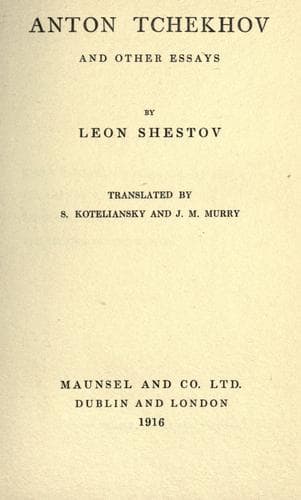
Chekhov, Anton Pavlovich, 1860-1904; Dostoyevsky, Fyodor, 1821-1881; Philosophy; Russian literature -- History and criticism
The question of the value of life, people object, is not at all
decided by whether in the sum life gives more joy than pain or _vice
versa._ Life may be deeply painful and devoid of joy, life may in
itself be one compact horror, and still be valuable. Schopenhauer's
philosophy was not discussed in his lifetime, so that he could not
answer his opponents. But, if he were still alive, would he accept
these objections and renounce his pessimism? I am convinced that he
would not. At the same time I am convinced that his opponents would
be no less firm and would go on repeating: 'The question is not one
of happiness or suffering. We value life by a quite different and
independent standard.' And in the discussion it would perhaps become
clear to the disputants that the premiss mentioned above, which both
accepted as requiring no proof and understood without explanation, does
indeed require proofs and explanations, but is provided with neither.
To one man the eudaemonistic point of view is ultimate and decisive,
to another contemptible and degrading, and he seeks the meaning of
life in a higher, ethical or aesthetic purpose. There are also people
who love sorrow and pain, and see in them the justification and the
source of the depth and importance of life. Nor do I mention the fact
that when the sum-totals of life are reckoned different accountants
reach different and directly contradictory results, or that insoluble
questions arise concerning these, or other details. Schopenhauer for
instance finds, as we have seen, that sufferings are positive, joys
negative. And hence he concludes that it is not worth while to submit
to the least unpleasantness for the sake of the greatest joy. What
answer can be made? How can he be convinced of the contrary?
Nevertheless the fact is obvious: many people regard the matter in
quite a different light. For the sake of a single happiness they
are ready to endure a great many serious hardships. In a word,
Schopenhauer's premiss is quite unjustified, and not only cannot
be accepted as an indubitable truth, but must be qualified as an
indubitable error. It is impossible to be certain beforehand that to
the question of the value of life a single, universally valid answer
can be given. So here we meet with an extraordinarily curious case
from the point of view of the theory of knowledge. It appears that
by the very essence of the matter no uniform answer can be given
to one of the most important questions, perhaps the most important
question of philosophy. If you are asked what is life, good or evil,
you are obliged to say that life is both good and evil; or something
independent of good and evil; or a mixture of good and evil in which
there is more good than evil, or more evil than good.
Public-domain text, read in full here on John Shaqi.
Reviews
Reviews
No reviews yet
Be the first to share your thoughts on this work.
Elsewhere in the archive
Join the Discussion
Join the discussion
Sign in to leave a comment or review.
Sign InorCreate an account