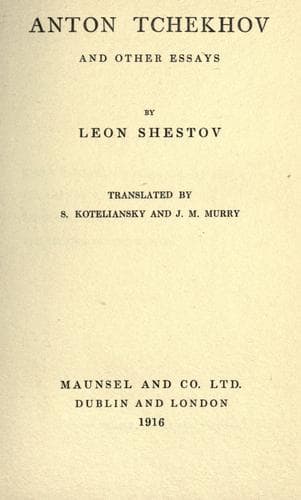
Chekhov, Anton Pavlovich, 1860-1904; Dostoyevsky, Fyodor, 1821-1881; Philosophy; Russian literature -- History and criticism
And, I repeat, each of these answers, although they logically quite
exclude each other, has the right to claim the title of _truth_; for
if it has not power enough to make the other answers bow down before
it, at all events it has the necessary strength to repel its opponents'
attacks and to defend its sovereign rights. Instead of a sole and
omnipotent truth before which the weak and helpless errors tremble,
you have before you a whole line of perfectly independent truths
excellently armed and defended. Instead of absolutism, you have a
feudal system. And the vassals are so firmly ensconced in their castles
that an experienced eye can see at once that they are impregnable.
I took for my instance Schopenhauer's doctrine of the value of life.
But many philosophic doctrines, although they issue from the premiss
of one sovereign truth, display examples of the plurality of truths.
It is usually believed that one should study the history of philosophy
in order to be palpably convinced that mankind has gradually mastered
its delusions and is now on the high road to ultimate truth. My opinion
is that the history of philosophy must bring every impartial person,
who is not infected by modern prejudices, to a directly opposite
conclusion. There can be no doubt that a whole series of questions
exists, like that of the value of life, which by their very essence
do not admit of a uniform solution. To this testimony is often borne
by men whose very last concern is to curtail the royal prerogative of
sovereign truth: Natorp confidently asserts that Aristotle not only did
not understand but could not understand Plato. 'Der tiefere Grund ist
die ewige Unfähigkeit des Dogmatismus sich in der Gesichtspunkt der
kritischen Philosophie überhaupt zu versetzen.' 'Eternal incapability'
--what words! And used not of any common-place person, but of the
greatest human genius known to us, of Aristotle. Had Natorp been a
little more inquisitive, 'eternal incapability' of that kind should
have worried him at least as much as Plato's philosophy, on which he
wrote a large book. For here is evidently a great riddle. Different
people, according to the different constitution of their souls,
are while yet in their mother's womb destined to have different
philosophies. It reminds me of the famous Calvinistic view of
predetermination. Just as from before birth God has destined some to
damnation, others to salvation; so to some it is given and from others
withheld, to know the truth.
Public-domain text, read in full here on John Shaqi.
Reviews
Reviews
No reviews yet
Be the first to share your thoughts on this work.
Elsewhere in the archive
Join the Discussion
Join the discussion
Sign in to leave a comment or review.
Sign InorCreate an account