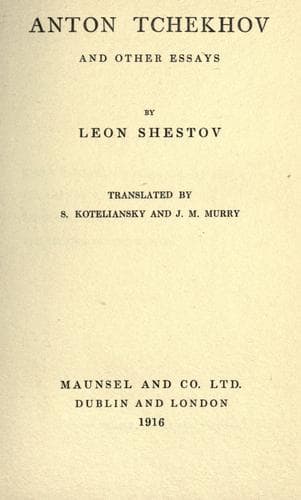
Chekhov, Anton Pavlovich, 1860-1904; Dostoyevsky, Fyodor, 1821-1881; Philosophy; Russian literature -- History and criticism
And surely not Nietzsche alone acted thus. The whole history of ethics,
the whole history of philosophy is to no small degree the incessant
search for prerogative and privilege, patents and charters. The
Christians--Tolstoi and Dostoevsky--do not in the least differ from
the enemy of Christianity, Nietzsche. The humble Jew, Spinoza, and the
meek pagan, Socrates, the idealist Plato, and the idealist Aristotle,
the founders of the newest, noblest and loftiest systems, Kant, Fichte,
Hegel, even Schopenhauer, the pessimist, all as one man seek a charter,
a charter, a charter. Evidently life on earth without a charter
becomes for the 'best' men a horrible nightmare and an intolerable
torment. Even the founder of Christianity, who so easily renounced all
privileges, considered it possible to preserve _this_ privilege for
his disciples, and perhaps--who knows?--for himself too.
Whereas if Nietzsche and those other philosophers had been able
resolutely to renounce titles, ranks, and honours, which are
distributed not only by morality, but by all the other Sanhedrim,
real and imaginary, which are set over man; if they could have drunk
this cup to the dregs, then they might have known, seen, and heard
much that was suspected by none of them before. Long since men have
known that the road to knowledge lies by way of a great renunciation.
Neither righteousness nor genius gives a man privilege above others.
He is deprived, for ever deprived, of the protection of earthly laws.
There are no laws. To-day he is a king, to-morrow a slave; to-day God,
to-morrow a worm; to-day first, to-morrow last. And the worm crushed
by him to-day will be God, his god to-morrow. All the measures and
balances by which men are distinguished one from another are defaced
for ever, and there is no certainty that the place a man once occupied
will still be his. And all philosophers have known this; Nietzsche,
too, knew it, and by experience. He was the friend, the ally, and
the collaborator of the great Wagner, the herald of a new era upon
earth; and later, he grovelled in the dust, broken and crushed.
And a second time this thing happened to him. When he had finished
_Zarathustra,_ he became insane, more exactly, he became half-idiot.
It is true he carried the secret of the second fall with him to the
grave. Yet something has reached us, for all his sister's efforts to
conceal from carnal eyes the change that had befallen him. And now
we ask: Is the essence of life really in the rank, the charter, the
patent of nobility? And can the words of Christ be understood in their
literal sense? Are not all the Sanhedrim set over man, and as it were
giving meaning to his life, mere fictions, useful and even necessary
in certain moments of life, but pernicious and dangerous, to say no
more, when the circumstances are changed? Does not life, the real and
desirable life, which men have sought for thousands of years, begin
there where there is neither first nor last, righteous or sinner,
Public-domain text, read in full here on John Shaqi.
Reviews
Reviews
No reviews yet
Be the first to share your thoughts on this work.
Elsewhere in the archive
Join the Discussion
Join the discussion
Sign in to leave a comment or review.
Sign InorCreate an account