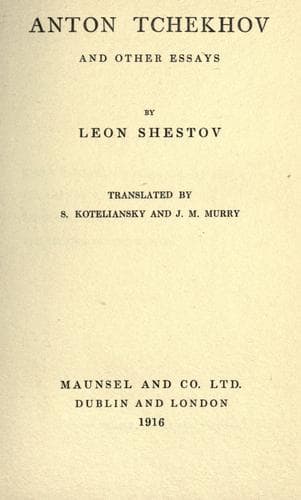
Chekhov, Anton Pavlovich, 1860-1904; Dostoyevsky, Fyodor, 1821-1881; Philosophy; Russian literature -- History and criticism
All morality, all good in and for itself is rejected, but the patent of
nobility grows more precious until it becomes, if not the only value,
at least the chief. Life loses its meaning once titles and ranks are
destroyed, once he is deprived of the right to hold his head high, to
throw out his chest, his belly even, and to look with contempt upon
those about him.
In order to show to what extent the doctrine of rank has become
attached to the human soul, I would recall the words of the Gospel
about the first and last. Christ, who seemed to speak in a language
utterly new, who taught men to despise earthly blessings--riches, fame,
honours, who so easily yielded Caesar his due, because he thought
that only Caesar would find it useful--Christ himself, when he spoke
to men, did not think it possible to take away from them their hope
of distinction. 'The first shall be last.' What will there be first
and second there, too? Yes, so it stands in the Gospel. Is it because
there is indeed in the division of men into ranks something original
and warrantable, or is it because Christ who spoke to humankind could
not but use human words? It may be that, but for that promise, and
generally the series of promises of rewards, accessible to the human
understanding, the Gospel would not have fulfilled its great historic
mission, it would have passed unnoticed on the earth, and no one
would have detected or recognised in it the Evangel. Christ knew that
men could renounce all things, save the right to superiority alone,
to superiority over one's neighbours, to that which Nietzsche calls
'the patent of nobility.' Without that superiority men of a certain
kind cannot live. They become what the Germans so appropriately call
_Vogelfrei,_ deprived of the protection of the laws, since the laws
are the only source of _their_ right. Rude, nonsensical, disgusting
reality--against which, I repeat, their _only_ defence is the patent
of nobility, the unwritten charter--approaches them closer and closer,
with more and more menace and importunacy, and claims its right. 'If
you are the same as all other men,' it says, 'take your experience
of life from me, fulfil your trivial obligations, worse than that,
accept from me the fines and reprimands to which the rank and file
are subject, even to corporal punishment.' How could he accept these
degrading conditions who had been used to think he had the right to
carry his head high, to be proud and independent? Nietzsche tries
with dull submissiveness to swallow the horrible bitterness of
his confession, but courage and endurance, even _his_ courage and
endurance, are not enough for this his greatest and most terrible task.
He cannot bear the horror of a life deprived of rights and defences: he
seeks again for power and authority which would protect him and give
him his lost rights again. He will not rest until he receives under
another name a _restitutio in integrum_ of all the rights which had
previously been his.
Public-domain text, read in full here on John Shaqi.
Reviews
Reviews
No reviews yet
Be the first to share your thoughts on this work.
Elsewhere in the archive
Join the Discussion
Join the discussion
Sign in to leave a comment or review.
Sign InorCreate an account