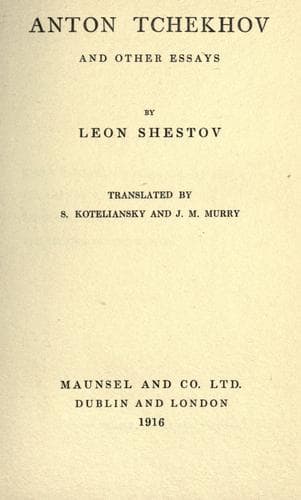
Chekhov, Anton Pavlovich, 1860-1904; Dostoyevsky, Fyodor, 1821-1881; Philosophy; Russian literature -- History and criticism
But the professor has not the word to give. He turns the conversation
to the weather, Kharkov and other indifferent matters. Katy gets up and
holds out her hand to him, without looking at him. 'I want to ask her,'
he concludes his story. '"So it means you won't be at my funeral?" But
she does not look at me; her hand is cold and like a stranger's ... I
escort her to the door in silence.... She goes out of my room and walks
down the long passage, without looking back. She knows that my eyes are
following her, and probably on the landing she will look back. No, she
did not look back. The black dress showed for the last time, her steps
were stilled.... Good-bye, my treasure!...'
The only answer which the wise, educated, long-lived Nicolai
Stepanovich, a teacher all his life, can give to Katy's question is,
'I don't know.' There is not, in all his great experience of the
past, a single method, rule, or suggestion, which might apply, even in
the smallest degree, to the wild incongruity of the new conditions of
Katy's life and his own. Katy can live thus no longer; neither can he
himself continue to endure his disgusting and shameful helplessness.
They both, old and young, with their whole hearts desire to support
each other; they can between them find no way. To her question: 'What
shall I do?' he replied: 'I shall soon be dead.' To his 'I shall
soon be dead' she answers with wild sobbing, wringing her hands, and
absurdly repeating the same words over and over again. It would have
been better to have asked no question, not to have begun that frank
conversation of souls. But they do not yet understand that. In their
old life talk would bring them relief and frank confession, intimacy.
But now, after such a meeting they can suffer each other no longer.
Katy leaves the old professor, her foster-father, her true father and
friend, in the knowledge that he has become a stranger to her. She
did not even turn round towards him as she went away. Both felt that
nothing remained save to beat their heads against the wall. Therein
each acts at his own peril, and there can be no dreaming of a consoling
union of souls.
VI
Public-domain text, read in full here on John Shaqi.
Reviews
Reviews
No reviews yet
Be the first to share your thoughts on this work.
Join the Discussion
Join the discussion
Sign in to leave a comment or review.
Sign InorCreate an account