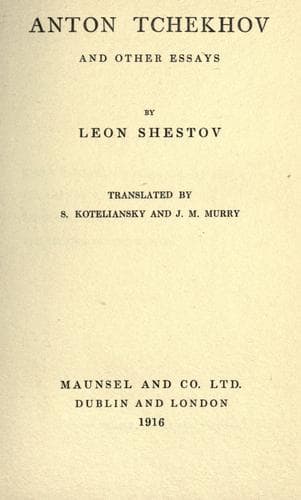
Chekhov, Anton Pavlovich, 1860-1904; Dostoyevsky, Fyodor, 1821-1881; Philosophy; Russian literature -- History and criticism
We can afford to be honest: but we need to learn how, or to increase
our knowledge. The Russian writers will help us in this; and not the
great Russians only, but the lesser also. For a century of bitter
necessity has taught that nation that the spirit is mightier than the
flesh, until those eager qualities of soul that a century of social
ease has almost killed in us are in them well-nigh an instinct. Let
us look among ourselves if we can find a Wordsworth, a Shelley, a
Coleridge, or a Byron to lift this struggle to the stars as they did
the French Revolution. There is none.--It will be said: 'But that was
a great fight for freedom. Humanity itself marched forward with the
Revolutionary armies.' But if the future of mankind is not in issue
now, if we are fighting for the victory of no precious and passionate
idea, why is no voice of true poetry uplifted in protest? There is
no third way. Either this is the greatest struggle for right, or the
greatest crime, that has ever been. The unmistakable voice of poetry
should be certain either in protest or enthusiasm: it is silent or
it is trivial. And the cause must be that the keen edge of the soul
of those century-old poets which cut through false patriotism so
surely is in us dulled and blunted. We must learn honesty again:
not the laborious and meagre honesty of those who weigh advantage
against advantage in the ledger of their minds, but the honesty that
cries aloud in instant and passionate anger against the lie and the
half-truth, and by an instinct knows the authentic thrill of contact
with the living human soul.
Public-domain text, read in full here on John Shaqi.
Reviews
Reviews
No reviews yet
Be the first to share your thoughts on this work.
Join the Discussion
Join the discussion
Sign in to leave a comment or review.
Sign InorCreate an account