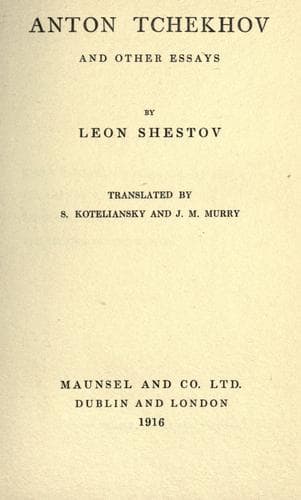
Chekhov, Anton Pavlovich, 1860-1904; Dostoyevsky, Fyodor, 1821-1881; Philosophy; Russian literature -- History and criticism
Vladimir Soloviev used to call Dostoevsky 'the prophet,' and even
'the prophet of God.' Immediately after Soloviev, though often in
complete independence of him, very many people looked upon Dostoevsky
as the man to whom the books of human destiny were opened; and this
happened not only after his death, but even while he was yet alive.
Apparently Dostoevsky himself too, if he did not regard himself as a
prophet--he was too eagle-eyed for that--at least thought it right
that all people should see a prophet in him. To this bears witness
the tone of _The Journal of an Author,_ no less than the questions
upon which he generally touches therein. _The Journal of an Author_
began to appear in 1873, that is on Dostoevsky's return from abroad,
and therefore coincides with what his biographers call 'the highest
period of his life.' Dostoevsky was then the happy father of a family,
a man of secure position, a famous writer, the author of a whole
series of novels known to all: _The House of the Dead, The Idiot, The
Possessed._ He has everything which can be required _from_ life, or,
more truly, he has taken everything which can be taken from life. You
remember Tolstoi's deliberations in his _Confession_? 'Finally, I shall
be as famous as Pushkin, Gogol, Goethe and Shakespeare--and what shall
come after?' Indeed, it is difficult to become a more famous writer
than Shakespeare; and even if one succeeded, the inevitable question,
'And what shall come after?' would by no means be removed. Sooner or
later in the activity of a great writer a moment comes when further
perfection seems impossible. How shall a man be greater than himself
in the world of literature? If he would move, then by his own will or
in spite of it he must step on to another plane. And this is plainly
the beginning of prophecy in a writer. In the general view the prophet
is greater than the writer; and even the possession of genius is not
always a guarantee against the general view. Even men so sceptical as
Tolstoi and Dostoevsky, men always ready to doubt everything, more than
once were the victims of prejudices. Prophetic words were expected
of them, and they went out to meet men's desires, Dostoevsky even
more readily than Tolstoi. Moreover both prophesied clumsily: they
promised one thing, and something wholly different happened. So Tolstoi
promised long ago that men would awake to their error soon and would
put away from them fratricidal war, and would begin to live as true
Christians should, fulfilling the Gospel commandment of love. Tolstoi
prophesied and preached; people read him, as, it seems, they read no
other writer: but they have not changed their habits nor their tastes.
For the last ten years Tolstoi has perforce been a witness of a whole
series of horrible and most savage wars. And now there is our present
revolution[1]--armed mobs rioting, the gallows set up, men shot down,
bombs--the revolution which came to replace the bloody war in the Far
East!
Public-domain text, read in full here on John Shaqi.
Reviews
Reviews
No reviews yet
Be the first to share your thoughts on this work.
Join the Discussion
Join the discussion
Sign in to leave a comment or review.
Sign InorCreate an account