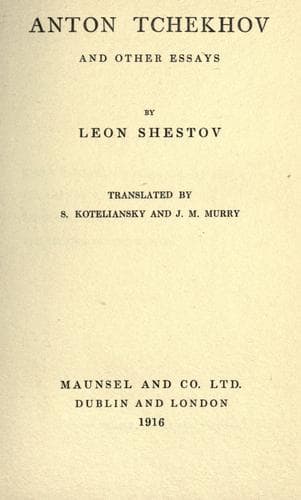
Chekhov, Anton Pavlovich, 1860-1904; Dostoyevsky, Fyodor, 1821-1881; Philosophy; Russian literature -- History and criticism
that Russia must 'serve the nations'--how could he be taken with an
idea so rapacious? And indeed almost all his political ideas have the
mark of rapacity upon them: to grab and grab, and still to grab....
As the occasion demands, he now expresses the hope that we may have
Germany's friendship, and again threatens her; now he argues that we
have need of England, and again he asserts that we could do without
her,--just like a leader-writer in a _bien-pensant_ provincial paper.
One thing alone makes itself felt among all these ludicrous and
eternally contradictory assertions,--Dostoevsky understands nothing,
absolutely nothing, about politics, and moreover, he has nothing at all
to do with politics. He is forced to go in tow of others who, compared
with him, are utter nonentities, and he goes. Even his ambition--and he
had a colossal ambition, an ambition unique in its kind, as befitted
a universal man--suffers not one whit: chiefly because men expected
prophecy from him, because the next title to that of a great writer is
that of a prophet, and because a ring of conviction and a loud voice
are the signs of the prophetic gift. Dostoevsky could speak aloud: he
could also speak with the tone of one who knows secrets, and of one
with authority. One learns much in the underworld. All these things
served him. Men took the poet-laureate of the existing order for the
inspirer of thoughts and the governor of Russia's remotest destinies.
It was enough for Dostoevsky. It was even necessary for Dostoevsky. He
knew of course that he was no prophet; but he knew that there had never
been one on earth, and that those who were prophets had no better right
to the title than he.
III
I will permit myself to remind the reader of Tolstoi's letter to his
son, lately published by the latter in the newspapers. It is very
interesting. Once more, not from the standpoint of the practical man
who has to decide the questions of the day--from this standpoint
Tolstoi, Dostoevsky, and their similars are quite useless--but man does
not live by bread alone.
Even now in the terrible days through which we have to live, now, if
you will, more than ever before, one cannot read newspapers alone, nor
think only of the awful surprises which to-morrow prepares for us. To
every one is left an hour of leisure between the reading of newspapers
and party programmes, if it be not an hour in the day when the noise
of events and the pressure of immediate work distracts, then an hour
in the deep night, when everything that was possible has been already
done, and everything that was required has been said. Then come flying
in the old thoughts and questions, frightened away by business, and
for the thousandth time one returns to the mystery of human genius and
human greatness. Where and how far can genius know and accomplish more
than ordinary men?
Public-domain text, read in full here on John Shaqi.
Reviews
Reviews
No reviews yet
Be the first to share your thoughts on this work.
Join the Discussion
Join the discussion
Sign in to leave a comment or review.
Sign InorCreate an account