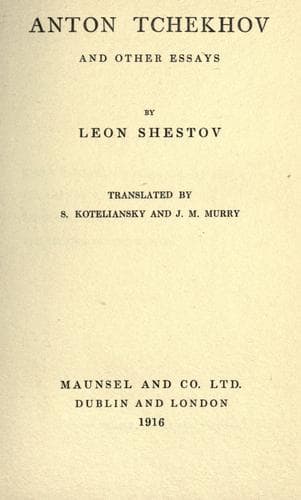
Chekhov, Anton Pavlovich, 1860-1904; Dostoyevsky, Fyodor, 1821-1881; Philosophy; Russian literature -- History and criticism
Now we may return to Dostoevsky and his 'ideas'; we may call them
fearlessly by the names which they deserve, for though Dostoevsky is
a writer of genius, this does not mean that we must forget our daily
needs. The night and the day have each their rights. Dostoevsky wanted
to be a prophet, he wanted people to listen to him and cry 'Hosanna!'
because, I say again, he thought that if men had ever cried 'Hosanna!'
to any one, then there was no reason why he, Dostoevsky, should be
denied the honour. That is the reason why in the 'seventies he made his
appearance in the new rôle of a preacher of Christianity, and not of
Christianity merely, but of orthodoxy.
Again, I would draw attention to the far from accidental circumstances
that his preaching coincided with the 'serenest' period of his life. He
who had in time past been a homeless wanderer, a poor man who had not
where to lay his head, had provided himself with a family and a house
of his own, even with money (for his wife was saving). The failure
had become a celebrity; the convict a full citizen. The underworld,
where-into his fate had but lately driven him, it might seem for ever,
now appeared to him a phantasmagoria which never had been real. In the
galleys and the underworld had been born within him a great hunger for
God which lived long; there he fought a great fight, the fight of life
against death; there for the first time were made the new and awful
experiments which allied Dostoevsky with everything that is rebellious
and restless on earth. What Dostoevsky wrote during the closing years
of his life (not merely _The Journal of an Author,_ but _The Brothers
Karamazov_ as well) has value only in so far as Dostoevsky's _past_
is reflected therein. He made no new step onwards. As he was, so he
remained, on the eve of a great truth. But in the old days that did
not suffice him, he hungered for something beyond; but now he does not
want to struggle, and he cannot explain to himself or to others what is
really happening within him. He pretends to be struggling still, nay,
more, he behaves as though he had won the final victory, and demands
that his triumph should be acknowledged by public opinion. He loves to
think that the night is already past and the actual day begun: and the
galleys and the underworld, reminding him that the day is not yet, are
no more. All the evidences of a complete illusion of victory seem to
be there--let him only choose the text and preach! Dostoevsky clutched
at orthodoxy. Why not Christianity? Because Christianity is not for
him who has a house, a family, money, fame, and a father-land. Christ
said: 'Let him leave all that he hath and follow me.' But Dostoevsky
was afraid of solitude, he desired to be the prophet of modern, settled
men to whom pure Christianity, unadapted to the needs of civilised
existence in a governed state, is unfitted. How should a Christian
seize Constantinople, drive out the Tartars from the Crimea, reduce
Public-domain text, read in full here on John Shaqi.
Reviews
Reviews
No reviews yet
Be the first to share your thoughts on this work.
Join the Discussion
Join the discussion
Sign in to leave a comment or review.
Sign InorCreate an account