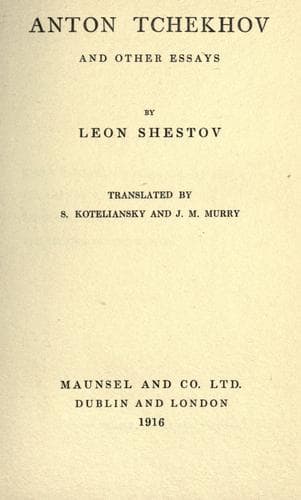
Chekhov, Anton Pavlovich, 1860-1904; Dostoyevsky, Fyodor, 1821-1881; Philosophy; Russian literature -- History and criticism
But there is no great harm done even if he did prophesy. I am glad
with all my heart even now that he rested a little while from the
galleys at the end of his life. I am deeply convinced that even had he
remained in the underworld until the day of his death, yet he would
have found no solution of the questions which tormented him. However
much energy of soul a man puts into his work, he will still remain 'on
the eve' of truth, and will not find the solution he desires. That is
the law of human kind. And Dostoevsky's preaching has done no harm.
Those listened to him who, even without his voice, would have marched
on Constantinople, oppressed the Poles, and made ready the sufferings
which are necessary to the soul of the peasant. Though Dostoevsky gave
them his sanction, on the whole he adds nothing to them. They had no
need of literary sanction, quite correctly judging that in practical
matters not the printed page, but bayonets and artillery are of
deciding value.
All that he had to tell, Dostoevsky told us in his novels, which even
now, twenty-five years after his death, attract all those who would
wrest from life her secrets. And the title of prophet, which he sought
so diligently, considering that it was his by right, did not suit him
at all. Prophets are Bismarcks, but they are Chancellors too. The
first in the village is the first in Rome.... Is a Dostoevsky doomed
eternally to be 'on the eve'? Let us once more try to reject logic,
this time perhaps not logic alone, and say: 'So let it be.'
[Footnote 3: _War and Christianity,_ by Vladimir Soloviev.]
PENULTIMATE WORDS
I
_De omnibus dubitandum_
There are but few orthodox Hegelians left among philosophers nowadays,
yet Hegel is still supreme over the minds of our contemporaries. It
may even be that certain of his ideas have taken deeper root nowadays
than when Hegelianism was in full bloom: for instance, the conception
that history is the unfolding of the idea in reality, or, to put it
more briefly and in terms more familiar to the modern mind--the idea of
progress. Try to convince an educated person of the contrary: you are
sure to be worsted. But, _de omnibus dubitandum,_ which means in other
words, that doubt is called upon to fulfil its mission above all in
those cases where a conviction is particularly strong and unshakable.
Therefore one must admit, whether he will or no, that progress so
called--the development of mankind in time--is a fiction.
We have wireless telegraphy, radium and the rest, yet we stand no
higher than the Romans or the Greeks of old. You admit this? Then,
one step further: although we have wireless telegraphy and all the
other blessings of civilisation, still we stand no higher than red-or
black-skinned savages. You protest: but the principle compels. You
began to doubt: then what is the use of drawing back?
Public-domain text, read in full here on John Shaqi.
Reviews
Reviews
No reviews yet
Be the first to share your thoughts on this work.
Join the Discussion
Join the discussion
Sign in to leave a comment or review.
Sign InorCreate an account