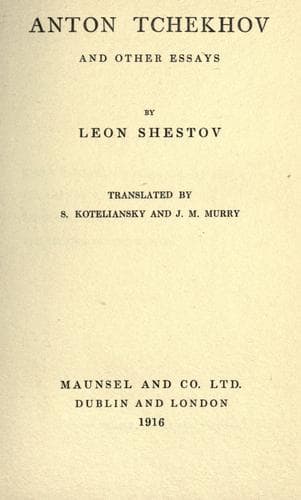
Chekhov, Anton Pavlovich, 1860-1904; Dostoyevsky, Fyodor, 1821-1881; Philosophy; Russian literature -- History and criticism
Not the least of Shestov's merits is that he is alive to this truth in
its twofold working. He is aware of himself as a soul seeking an answer
to its own question; and he is aware of other souls on the same quest.
As in his own case he knows that he has in him something truer than
names and divisions and authorities, which will live in spite of them,
so towards others he remembers that all that they wrote or thought or
said is precious and permanent in so far as it is the manifestation
of the undivided soul seeking an answer to its question. To know a
man's work for this, to have divined the direct relation between his
utterance and his living soul, is criticism: to make that relation
between one's own soul and one's speech direct and true is creation.
In essence they are the same: creation is a man's lonely attempt to
fix an intimacy with his own strange and secret soul, criticism is the
satisfaction of the impulse of loneliness to find friends and secret
sharers among the souls that are or have been. As creation drives a man
to the knowledge of his own intolerable secrets, so it drives him to
find others with whom he may whisper of the things which he has found.
Other criticism than this is, in the final issue, only the criminal and
mad desire to enforce material order in a realm where all is spiritual
and vague and true. It is only the jealous protest of the small soul
against the great, of the slave against the free.
Against this smallness and jealousy Shestov has set his face. To have
done so does not make him a great writer; but it does make him a real
one. He is honest and he is not deceived. But honesty, unless a man is
big enough to bear it, and often even when he is big enough to bear it,
may make him afraid. Where angels fear to tread, fools rush in: but
though the folly of the fool is condemned, some one must enter, lest
a rich kingdom be lost to the human spirit. Perhaps Shestov will seem
at times too fearful. Then we must remember that Shestov is Russian in
another sense than that I have tried to make explicit above. He is a
citizen of a country where the human spirit has at all times been so
highly prized that the name of thinker has been a key to unlock not
merely the mind but the heart also. The Russians not only respect,
but they love a man who has thought and sought for humanity, and, I
think, their love but seldom stops 'this side idolatry.' They will
exalt a philosopher to a god; they are even able to make of materialism
a religion. Because they are so loyal to the human spirit they will
load it with chains, believing that they are garlands. And that is why
dogmatism has never come so fully into its own as in Russia.
Public-domain text, read in full here on John Shaqi.
Reviews
Reviews
No reviews yet
Be the first to share your thoughts on this work.
Join the Discussion
Join the discussion
Sign in to leave a comment or review.
Sign InorCreate an account