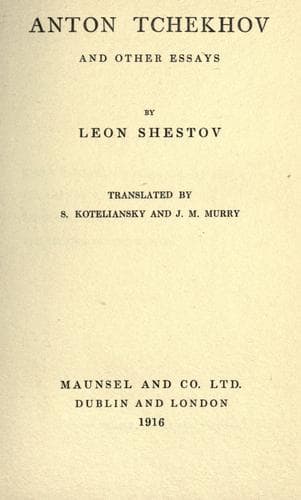
Chekhov, Anton Pavlovich, 1860-1904; Dostoyevsky, Fyodor, 1821-1881; Philosophy; Russian literature -- History and criticism
But these are all masters, who devise systems and imperatives. Whereas
the pupil, seeking in philosophy an answer to his questions, cannot
permit himself any liberties and digressions from the universal rules,
for the essence and the fundamental problem of any doctrine reduces to
the subordination not merely of men's conduct, but of the life of the
whole universe to one regulating principle. Individual philosophers
have discovered such principles, but to this day they have reached no
final agreement among themselves, and this to some extent lightens the
burden of those unhappy ones who, having lost the hope of finding help
and guidance elsewhere, have turned to philosophy. If there is not
in philosophy one universal principle binding upon and acknowledged
by all, it means that it is permitted to each man, at least for the
meantime, to feel and even to act in his own way. A man may listen
to Spinoza, or he may stop his ears. He may kneel before Plato's
eternal ideas, or he may give his allegiance to the ever-changing,
ever-flowing reality. Finally, he may accept Schopenhauer's pessimism,
but nothing on earth can compel him to celibacy on the ground that
Schopenhauer successfully laughed at love. Nor is there any necessity
at all, in order to win such freedom for one's self, to be armed
with the light dialectic of the old Greek philosopher, or with the
heavy logic of the poor Dutch Jew, or with the subtle wit of the
profound German. Neither is it necessary to dispute them. It is even
possible to agree with them all. The room of the world is infinite,
and will not only contain all those who lived once and those who are
yet to be born, but will give to each one of them all that he can
desire: to Plato, the world of ideas, to Spinoza, the one eternal and
unchangeable substance, to Schopenhauer, the Nirvana of Buddhism. Each
of these, and all the other philosophers, will find what they want in
the universe even to the belief, even to the conviction, that theirs
are the only true and universal doctrines. But, at the same time,
the profane will find suitable worlds for themselves. From the fact
that people are cooped up on the earth, and that they must put forth
efforts beyond belief to gain each cubit of earth, and even their
illusory liberties, it by no means follows that poverty, obscurantism,
and despotism must be considered eternal and original principles, and
that economical uniformity is the last refuge of man. A plurality of
worlds, a plurality of men and gods amid the vast spaces of the vast
universe--this is, if I may be forgiven the word, an ideal. It is true
it is not built according to the idealists. Yet what a conclusion does
it foreshadow! We leave the disputes and arguments of philosophers
aside, so soon as we begin to speak of gods. According to the existing
beliefs and hypotheses the gods also have always been quarrelling
and fighting among themselves. Even in monotheistic religions people
Public-domain text, read in full here on John Shaqi.
Reviews
Reviews
No reviews yet
Be the first to share your thoughts on this work.
Join the Discussion
Join the discussion
Sign in to leave a comment or review.
Sign InorCreate an account