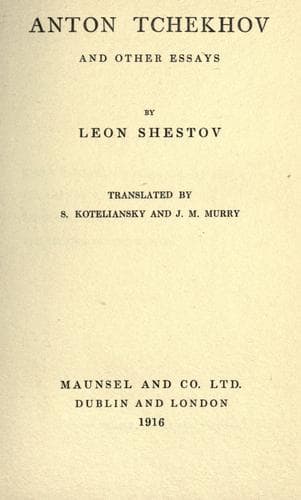
Chekhov, Anton Pavlovich, 1860-1904; Dostoyevsky, Fyodor, 1821-1881; Philosophy; Russian literature -- History and criticism
Nevertheless, our mind, in alliance with omnipotent habit, has,
with the assistance of some strained interpretation, given to the
combination of phenomena in the segment of universal life that is
accessible to us, a certain kind of harmony and unity, and this from
time immemorial has gained repute under the name of an intelligible
explanation of the created world. But the known, which is the familiar,
world is sufficiently unintelligible to make good faith require of us
that we should accept unintelligibility as the fundamental predicate
of being. It is impossible to hold, as some do, that the only reason
why we do not understand the world is that something is hidden from
us or that our mind is weak, so that if the Supreme Being wished to
unveil the secret of creation to us, or if the human brain should so
much develop in the next ten million years that he will excel us as
far as we excel our official ancestor, the ape, then the world will be
intelligible. No, no, no! By their very essence the operations which we
perform upon reality to understand it are useful and necessary only so
long as they do not pass a certain limit. It is possible to understand
the arrangement of a locomotive. It is also legitimate to seek an
explanation of an eclipse of the sun, or of an earthquake. But a moment
comes--only we cannot define it exactly--when explanations lose all
meaning and are good for nothing any more. It is as though we were led
by a rope--the law of sufficient reason--to a certain place and left
there: 'Now go wherever you like.' And since we have grown so used to
the rope in our lives, we begin to believe that it is part of the very
essence of the world. One of the most remarkable thinkers, Spinoza,
thought that God himself was bound by necessity.
Let any one probe himself carefully, and he will find that he is not
merely unable to think but almost unable to live without the hypothesis
of Spinoza. The work of Hume, who so brilliantly disputed the axiom
of causal necessity, was only half done. He clearly showed that it
is impossible to prove the existence of necessary connection. But it
is also impossible to prove the contrary. In the result, everything
remained as before: Kant, and all mankind after him, has returned to
Spinoza's position. Freedom has been driven into an intellectual world,
an unknown land,
'from whose bourne
No traveller returns,'
Public-domain text, read in full here on John Shaqi.
Reviews
Reviews
No reviews yet
Be the first to share your thoughts on this work.
Elsewhere in the archive
Join the Discussion
Join the discussion
Sign in to leave a comment or review.
Sign InorCreate an account