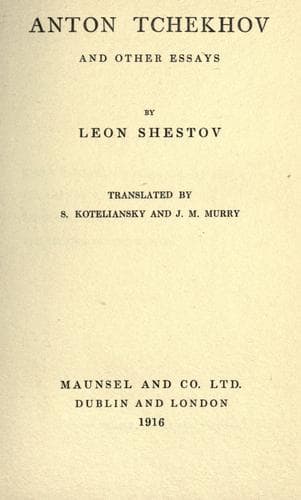
Chekhov, Anton Pavlovich, 1860-1904; Dostoyevsky, Fyodor, 1821-1881; Philosophy; Russian literature -- History and criticism
After all, not even the most consistent and convinced realist
represents life to himself as it really is. He overlooks a great deal;
and on the other hand he often sees something which has no existence in
reality. I do not think there is any need to show this by example. For
all our desire to be objective we are, after all, extremely subjective,
and those things which Kant calls synthetic judgments _a priori,_ by
which our mind forms nature and dictates laws to her, do play a great
and serious part in our lives. We create something like the veil of
Maia: we are awake in sleep, and sleep in wakefulness, exactly as
though some magic power had charmed us. And just as in sleep we feel
for instants that what is happening to us is like a half-dream, an
intermediate half-life. Schopenhauer and the Buddhists were right in
asserting that it is equally wrong to say of the veil of Maia, the
world accessible to us, either that it exists or does not exist. It is
true that logic does not admit such judgments and persecutes them most
implacably, for they violate its most fundamental laws. But it cannot
be helped: when one has to choose between philosophy which is alluring
and promising, and empty logic, one will always sacrifice the latter
for the former. And philosophy without contradictory judgments would
be either doomed to eternal silence, or would be churned into a mud of
commonplace and reduced to nothing. Philosophers know that. The same
is true of our own case: we must confess that we are at the same time
awake and dreaming dreams, and at times we must own that though we
are alive, yet we have long since been dead. As living beings we still
hold to the accepted synthetic judgments _a priori,_ and as dead, we
try to do without them, or to replace them by other judgments which
have nothing in common with the former but are even opposite to them.
Philosophy is occupied in this work with extreme diligence, and _in
this and this alone_ is the meaning of the idealistic movement which
has never, since the time of Plato, disappeared from history. The
problem is not for us to find another, primordial, better, and eternal
world to replace the visible world accessible to all, as idealistic
philosophy is usually interpreted by her official and, unfortunately,
her most influential representatives. Interpretation of that kind
too obviously bears the mark of its empiric utilitarian origin: they
bring us as near to super-empiric reality as do the notions wherewith
we define what is valuable in life. We might as well consider the
super-empiric world as one of gold, diamond, or pearls simply because
gold, diamonds, and pearls are very costly. But so it usually happens.
God himself is usually represented as glimmering with gold and precious
stones, as omniscient and omnipotent. He is called the King of Kings
since on earth the lot of a crowned head is considered most enviable.
The meaning and value of idealistic philosophy thus appears to be that
Public-domain text, read in full here on John Shaqi.
Reviews
Reviews
No reviews yet
Be the first to share your thoughts on this work.
Elsewhere in the archive
Join the Discussion
Join the discussion
Sign in to leave a comment or review.
Sign InorCreate an account