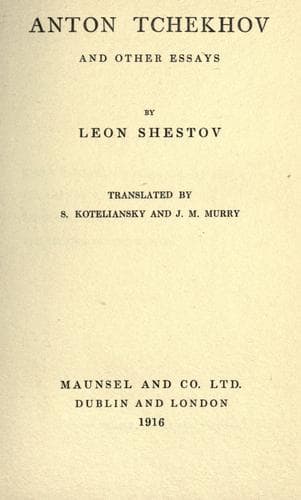
Chekhov, Anton Pavlovich, 1860-1904; Dostoyevsky, Fyodor, 1821-1881; Philosophy; Russian literature -- History and criticism
The law of causation as a principle of inquiry is an excellent thing:
the existing sciences afford us convincing evidence of that. But as an
idea in the Platonic sense it is of little value, at times at least.
The strict harmony and order of the world have fascinated many people:
such giants of thought as Spinoza and Goethe paused with reverent
wonder in contemplation of the great and unchangeable order of nature.
Therefore they exalted necessity even to the rank of a primordial,
eternal, original principle. And we must confess that Goethe's and
Spinoza's conception of the world lives so much in each one of us that
in most cases we can love and respect the world only when our souls
feel in it a symmetrical harmony. Harmony seems to us at once-the
highest value and the ultimate truth. It gives to the soul great peace,
a stable firmness, a trust in the Creator--the highest boons accessible
to mortal men, as the philosophers teach. Nevertheless, there are
other yearnings. Man's heart is suddenly possessed by a longing for
the fantastic, the unforeseen, for that which cannot be foreseen. The
beautiful world loves its beauty, peace of soul seems disgraceful,
stability is felt as an intolerable burden. Just as a youth grown
to manhood suddenly feels irritated by the bountiful tutelage of
his parents, from which he has received so much, though he does not
know what to do with his freedom, so is a man of insight ashamed of
the happiness which is given to him, which some one has created. The
law of causation, like the whole harmony of the world, seems to him
a pleasant gift, facilitating life, but yet a degrading one. He has
sold his birthright for peace, for undisturbed happiness--his great
birthright of free creation. He does not understand how a giant like
Goethe could have been seduced by the temptation of a pleasant life,
he suspects the sincerity of Spinoza. There is something rotten in the
state of Denmark. The apple of the tree of knowledge of good and evil,
has become to him the sole purpose of life, even though the path to it
should lie through extreme suffering.
Public-domain text, read in full here on John Shaqi.
Reviews
Reviews
No reviews yet
Be the first to share your thoughts on this work.
Elsewhere in the archive
Join the Discussion
Join the discussion
Sign in to leave a comment or review.
Sign InorCreate an account