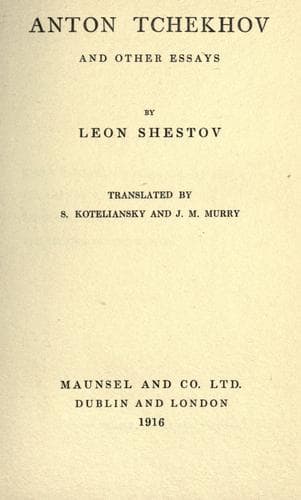
Chekhov, Anton Pavlovich, 1860-1904; Dostoyevsky, Fyodor, 1821-1881; Philosophy; Russian literature -- History and criticism
And, strangely, nature herself seems to be preoccupied in urging man to
that fatal path. There comes a time in our life when some imperative
and secret voice forbids us to rejoice at the beauty and grandeur of
the world. The world allures us as before, but it no longer gives pure
happiness. Remember Tchekhov. How he loved nature! What immeasurable
yearning is audible in his wonderful descriptions of nature! Just as
though each time that he glanced at the blue sky, the troubled sea or
the green woods, a voice of authority whispered to him: 'All this is
yours no longer. You may look at it, but you have no right to rejoice.
Prepare yourself for another life, where nothing will be given,
complete, prepared, where nothing will be created, where there will
be illimitable creation alone. And everything which is in this world
shall be given to destruction, to destruction and destruction, even
this nature which you so passionately love, and which it is so hard and
painful for you to renounce.' Everything drives us to the mysterious
realm of the eternally fantastic, eternally chaotic, and--who
knows?--it may be, the eternally beautiful....
_Experiment and Proof_
When _cogito ergo sum_ came into Descartes' head, he marked the
day--November 10, 1619--as a remarkable day: 'The light of a wonderful
discovery,' he wrote in his diary, 'flashed into my mind.' Schelling
relates the same thing of himself: in the year 1801 he 'saw the light.'
And to Nietzsche when he roamed the mountains and the valleys of
the Engadine there came a mighty change: he grasped the doctrine of
eternal recurrence. One might name many philosophers, poets, artists,
preachers, who like these three suddenly saw the light, and considered
their vision the beginning of a new life. It is even probable that all
men who have been destined to display to the world something perfectly
new and original have without exception experienced that miracle of
sudden metamorphosis. Nevertheless, though much is spoken of these
miracles and often, in nearly all biographies of great men, we cannot
strictly make any use of them. Descartes, Schelling, Nietzsche tell
the story of their conversion; and with us, Tolstoi and Dostoevsky
tell of theirs; in the less remote past, there are Mahomet and Paul
the Apostle; in far antiquity the legend of Moses. But if I had
chosen tenfold the number, if thousands even had been collected, it
would still be impossible for the mind to make any deduction from
them. In other words, all these cases have no value as scientific
material, whereas one fossil skeleton or a unique case of an unknown
rare disease is a precious windfall to the scientist. What is still
more interesting, Descartes was so struck with his _cogito ergo sum,_
Nietzsche with his eternal recurrence, Mahomet with his paradise, Paul
the Apostle with his vision, while we remain more or less indifferent
to anything they may relate of their experiences. Only the most
Public-domain text, read in full here on John Shaqi.
Reviews
Reviews
No reviews yet
Be the first to share your thoughts on this work.
Elsewhere in the archive
Join the Discussion
Join the discussion
Sign in to leave a comment or review.
Sign InorCreate an account