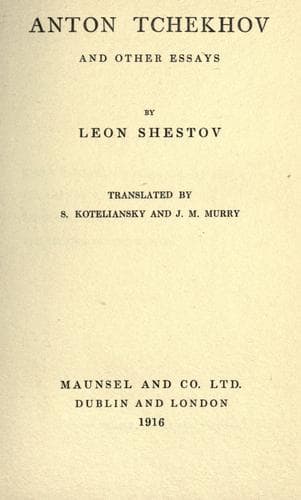
Chekhov, Anton Pavlovich, 1860-1904; Dostoyevsky, Fyodor, 1821-1881; Philosophy; Russian literature -- History and criticism
In this respect poets were the same as the rest of people. From some
mysterious source they had acquired truths, often great and profound,
but they were unable to explain them. This seemed to Socrates a great
misery, a real misfortune. I do not know how it happened--not a single
historian of philosophy has explained it, and indeed very little
interest has been taken in it--but Socrates for some reason decided
that an unproven and unexplained truth had less value than a proven and
explained one. In our times, when a whole theory, even a conception
of the world, has been made of Socrates's idea, this notion seems
so natural and self-evident that no one doubts it. But in antiquity
the case was different. Strictly, Socrates thought that the poets
had acquired their truths, which they were unable to prove, from a
very respectable source, which deserved all possible confidence: he
himself compared the poets with oracles, and consequently admitted
that they had communion with the gods. There was, therefore, a most
excellent guarantee that the poets were possessed of real, undiluted
truth--the pledge of its purity being the divine authority. Socrates
said that he himself had frequently been guided in his actions, not by
considerations of reason, but by the voice of his mysterious 'demon.'
That is, at times, he abstained from certain actions--his demon gave
him never positive, but only negative advice--without being able to
produce reasons, simply because the secret voice, more authoritative
than any human mind, demanded abstinence from them.
Public-domain text, read in full here on John Shaqi.
Reviews
Reviews
No reviews yet
Be the first to share your thoughts on this work.
Elsewhere in the archive
Join the Discussion
Join the discussion
Sign in to leave a comment or review.
Sign InorCreate an account