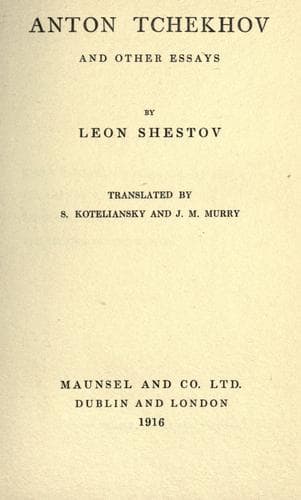
Chekhov, Anton Pavlovich, 1860-1904; Dostoyevsky, Fyodor, 1821-1881; Philosophy; Russian literature -- History and criticism
Is it not strange that under such circumstances, at an epoch when the
gods vouchsafed truths to men, there should have suddenly appeared in
a man the unexplained desire to acquire truths without the help of the
gods, and in independence of them, by the dialectic method so beloved
of the Greeks? It is doubtful which is more important for us, to
acquire the truth or to acquire for one's self with one's own effort,
it may be a false, but one's _own_ judgment. The example of Socrates,
who has been a pattern for all subsequent generations of thinking
men, leaves not the slightest doubt. Men do not need a truth ready
made; they turn away from the gods to devote themselves to independent
creations. Practically the same story is told in the Bible. What indeed
was lacking to Adam? He lived in paradise, in direct proximity to God,
from whom he could learn anything he wanted. And yet it did not suit
him. It was enough that the Serpent should make his perfidious proposal
for the man to forget the wrath of God, and all the dangers which
threatened him, and to pluck the apple from the forbidden tree. Then
the truth, which until the creation of the world and man had been one,
split and broke with a great, perhaps an infinitely great, number of
most diverse truths, eternally being born, and eternally dying. This
was the seventh day of creation, unrecorded in history. Man became
God's collaborator. He himself became a creator. Socrates renounced the
divine truth and even spoke contemptuously of it, merely because it
was not proven, that is, because it does not bear the marks of man's
handiwork. Socrates really did not prove anything, but he was proving,
creating, and in this he saw the meaning of his own life and of all
human lives. Thus, surely, the pronouncement of the Delphic oracle
seems true even now: Socrates was the wisest of men. And he who would
be wise must, imitating Socrates, not be like him in anything. Thus did
all great men, and all great philosophers.
_What does the History of Philosophy teach us?_
Public-domain text, read in full here on John Shaqi.
Reviews
Reviews
No reviews yet
Be the first to share your thoughts on this work.
Elsewhere in the archive
Join the Discussion
Join the discussion
Sign in to leave a comment or review.
Sign InorCreate an account