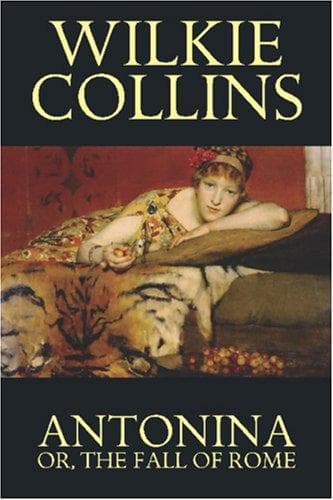
Produced by Bronwyn Margaret Evans. HTML version by Al Haines.
ANTONINA
OR, THE FALL OF ROME
by
WILKIE COLLINS
PREFACE
In preparing to compose a fiction founded on history, the writer of
these pages thought it no necessary requisite of such a work that the
principal characters appearing in it should be drawn from the
historical personages of the period. On the contrary, he felt that
some very weighty objections attached to this plan of composition. He
knew well that it obliged a writer to add largely from invention to
what was actually known--to fill in with the colouring of romantic
fancy the bare outline of historic fact--and thus to place the
novelist's fiction in what he could not but consider most unfavourable
contrast to the historian's truth. He was further by no means
convinced that any story in which historical characters supplied the
main agents, could be preserved in its fit unity of design and
restrained within its due limits of development, without some
falsification or confusion of historical dates--a species of poetical
licence of which he felt no disposition to avail himself, as it was his
main anxiety to make his plot invariably arise and proceed out of the
great events of the era exactly in the order in which they occurred.
Influenced, therefore, by these considerations, he thought that by
forming all his principal characters from imagination, he should be
able to mould them as he pleased to the main necessities of the story;
to display them, without any impropriety, as influenced in whatever
manner appeared most strikingly interesting by its minor incidents; and
further, to make them, on all occasions, without trammel or hindrance,
the practical exponents of the spirit of the age, of all the various
historical illustrations of the period, which the Author's researches
among conflicting but equally important authorities had enabled him to
garner up, while, at the same time, the appearance of verisimilitude
necessary to an historical romance might, he imagined, be successfully
preserved by the occasional introduction of the living characters of
the era, in those portions of the plot comprising events with which
they had been remarkably connected.
On this plan the recent work has been produced.
To the fictitious characters alone is committed the task of
representing the spirit of the age. The Roman emperor, Honorius, and
the Gothic king, Alaric, mix but little personally in the business of
the story--only appearing in such events, and acting under such
circumstances, as the records of history strictly authorise; but exact
truth in respect to time, place, and circumstance is observed in every
historical event introduced in the plot, from the period of the march
of the Gothic invaders over the Alps to the close of the first
barbarian blockade of Rome.
CONTENTS.
CHAPTER 1. GOISVINTHA.
CHAPTER 2. THE COURT.
CHAPTER 3. ROME.
CHAPTER 4. THE CHURCH.
CHAPTER 5. ANTONINA.
Public-domain text, read in full here on John Shaqi.
Reviews
Reviews
No reviews yet
Be the first to share your thoughts on this work.
Join the Discussion
Join the discussion
Sign in to leave a comment or review.
Sign InorCreate an account