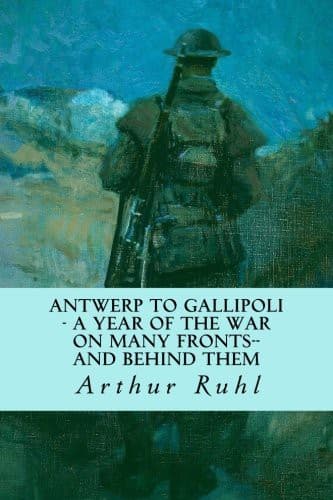
Antwerp to Gallipoli: A Year of the War on Many Fronts—and Behind ThemRuhl, Arthur
History
Antwerp to Gallipoli: A Year of the War on Many Fronts—and Behind Them
Ruhl, Arthur
World War, 1914-1918 -- Personal narratives
The dinner was served by one Dimitri, a brawny, slow-moving Greek.
Dimitri was dressed in a home-spun braided jacket and homespun Turkish
trousers, shaped like baggy riding-breeches, and his complete
impenetrability to new ideas was only equalled by the solemnity and
touching willingness with which he received them. It was after he had
served us in the ignoble capacity of dish-washer and burden-carrier for
several days that we were informed one evening by the governor's
secretary, in his vague way, that Dimitri was an "architect."
"Architecte naturel," suggested the urbane Philip, and the governor's
secretary assented. Slow Dimitri might be, but once he grasped an idea,
no power could drag it from him. When one asked him where he learned to
build houses of a certain style, he always replied that so they were
built by Pappadopoulos--Pappadopoulos being dead these twenty or thirty
years. Dimitri, the secretary ventured, had been architect of the
mosque on the water-front, and when he found that we were pleased with
this idea, everything else in Gallipoli became Dimitri's. The
lighthouse, the hospital, the three white houses by the quay--we had but
to mention a building and he would promptly murmur, in his dreamy,
half-quizzical way;
"Oui-i-i ... c'est Dimitri!"
Early next morning, just after we had discovered that under the cliff
was water like liquid lapis lazuli and flat-topped rocks rising just
above it on which you would not have been in the least surprised to find
mermaids combing their hair, or sirens sitting, and that it was a simple
matter to climb down and be mermen, the clergyman-volunteer arrived
with reports of the first night. It had been dismal, there were one or
two intransigent kickers, and the aesthetic young Frenchman who spent
his idle time drawing pictures of fashion-plate young ladies, had become
so unstrung that he had regularly "thrown a fit" and been unconscious
for half an hour until they could massage him back to life again. Humor
was quite gone out of them, and when the clergyman suggested that it was
a compliment to be sent out to be shot at--flattering, at any rate, to
the prowess of the Allies--a Frenchman emphatically denied it. "Pas du
tout!" he exploded. While we talked there was a knock at the front
door, and through the grating we saw the red fez and vaguely smiling
visage of the mutessarif's secretary. It was the first of a series of
visits, which, before we left Gallipoli, were renewed almost every hour,
of dialogues deserving a better immortalization than can be given here.
Public-domain text, read in full here on John Shaqi.
Reviews
Reviews
No reviews yet
Be the first to share your thoughts on this work.
Elsewhere in the archive
Join the Discussion
Join the discussion
Sign in to leave a comment or review.
Sign InorCreate an account