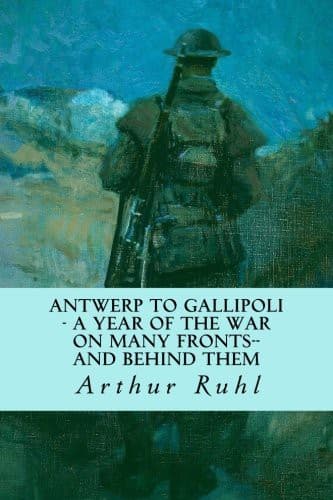
Antwerp to Gallipoli: A Year of the War on Many Fronts—and Behind ThemRuhl, Arthur
History
Antwerp to Gallipoli: A Year of the War on Many Fronts—and Behind Them
Ruhl, Arthur
World War, 1914-1918 -- Personal narratives
You must imagine, on one side of the dining-room table, the plump little
bey, with his fez and glasses, quick little salutes each time he took a
match or cigarette; facing him the tall, urbane Philip, in ineffable
flannels or riding-clothes--for the embassy secretary is one of those
who believe that clothes should express rather than blot out the inner
man. Cigarettes--coffee--assurances to his excellency that the house is
his, to Monsieur Le Directeur of our pleasure and profound
consideration. Minutes pass, an hour--the bey knows no such thing as
time, the other is as unhurried as he. The talk, in somewhat halting
French, is of war, weather, French culture, marriage, those dreadful
Russians, punctuated by delicate but persistently recurring references,
on one side, to mattresses and food for the hostages, by the little
bey's deep sighs and his "Mais ... que fairef"
That "But what can be done?" like the Mexican's "Who knows?" fell like a
curtain on every pause, it was the bey's answer to all life's riddles--
the plight of the hostages, the horrors of war, his own dream of being
governor of a province close to Constantinople. One can hear him now
through that cloud of cigarette smoke, "Mais--" with a pause and
scarcely perceptible lifting of the shoulders--"que faire..."
We went across to Lapsaki again that day to get blankets and buy or
order mattresses, and found it much what Gallipoli must have been a few
days before--sunshine and soldiers, camels loaded with stretchers and
Red Cross supplies, the hot little twisting streets, noisy with traders
and refugees.
You can imagine the excitement over this mysterious stranger with an
unlimited supply of gold lire and big silver medjidies, asking not what
kind of blankets, but how many did they have, how long would it take
them to make not one, but fifty mattresses! Greek traders, Jews from the
Dardanelles, one or two hybrid youths in fez and American clothes, with
recommendations from American Y. M. C. A.'s--it was a great afternoon
for Lapsaki!
A round-faced, jolly German nurse, dropped all alone in the little town
by the chance of war, met us in the street, and later we went to her
hospital. It had been started only a fortnight before, there were no
beds, and the wounded lay on narrow mattresses on the floor. One man,
whose face was a mere eyes and nose poking through patches of plaster,
had been burned at Gallipoli. Another, up from the Dardanelles, had a
hideous wound in his cheek, discharging constantly into his mouth. In
spite of it he took Philip's cigarette and smoked it. He was dead when
we came back three days later. On another mattress was a poor little
brown bundle, a boy of twelve or thirteen, hit in the spine and
paralyzed by a fragment of shell at Gallipoli and now delirious. Philip
later took him back to Constantinople, to the X-ray and care that might
save his life.
Public-domain text, read in full here on John Shaqi.
Reviews
Reviews
No reviews yet
Be the first to share your thoughts on this work.
Elsewhere in the archive
Join the Discussion
Join the discussion
Sign in to leave a comment or review.
Sign InorCreate an account