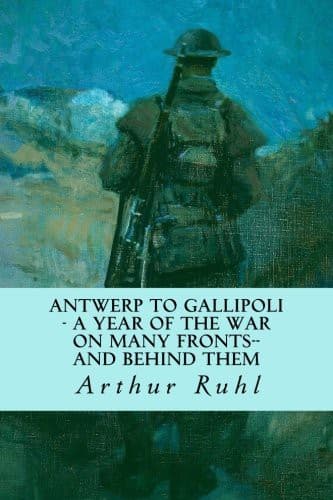
Antwerp to Gallipoli: A Year of the War on Many Fronts—and Behind ThemRuhl, Arthur
History
Antwerp to Gallipoli: A Year of the War on Many Fronts—and Behind Them
Ruhl, Arthur
World War, 1914-1918 -- Personal narratives
The young Frenchman lit a match--three-twenty. The little boy, rousing
from his corner, suddenly announced, apropos of nothing, that the
Germans ought to be dropped into kettles of boiling water; at once came
the voice of one of the little girls, sound asleep apparently before
this, warning him that he must not talk like that or the Germans might
hear and shoot them. We jolted on, backed, and suddenly one became
aware that the gray light was not that of the moon. The lady at my left
sat upright. "The day comes!" she said briskly. It grew lighter. We
passed sentries, rifles stacked on station platforms, woods--the forest
of St. Germain. These woods were misty blue in the cool autumn morning,
there were bivouac fires, coffee-pots on the coals, and standing beside
these fires soldiers in kepis and red trousers and heavy blue coats with
the flaps pinned back. Just such soldiers and scenes you have seen in
the war pictures of Detaille and De Neuville. Bridges, more houses, the
rectangular grass-covered faces of forts at last; just as Paris was
getting up for breakfast, into St. Lazare station, heaped with trunks
and boiling with people, Parisians, belated American tourists, refugees
from northeast villages, going somewhere, anywhere, to get away. It was
September 2.
There were miles of closed shops with placards on the shutters:
"Proprietor and personnel have been called to the colors"; no buses or
trams, the few 'cabs piled with the luggage of those trying to get away,
almost no way to traverse the splendid distances but to walk. Papers
could not be cried aloud on the streets, and the only news was the
official communiqué and a word about some Servian or Russian victory in
some un-pronounceable region of the East.
"France is a history, a life, an idea which has taken its place in the
world, and the bit of earth from which that history, that life, that
thought, has radiated, we cannot sacrifice without sealing the stone of
the tomb over ourselves and our children and the generations to follow
us." Thus George Clemenceau was writing in L'Homme Libre, and people
knew that this was true. And yet in that ghastly silence of Paris,
broken only by the constant flight of military automobiles, screaming
through the streets on missions nobody understood, those left behind did
not even know where the enemy was, where the defenders were, or what was
being done to save Paris. And it gradually, and not unnaturally, seemed
to the more nervous that nothing had been done--the forts were paper,
the government faithless, revolution imminent--one heard the wildest
things.
Public-domain text, read in full here on John Shaqi.
Reviews
Reviews
No reviews yet
Be the first to share your thoughts on this work.
Join the Discussion
Join the discussion
Sign in to leave a comment or review.
Sign InorCreate an account