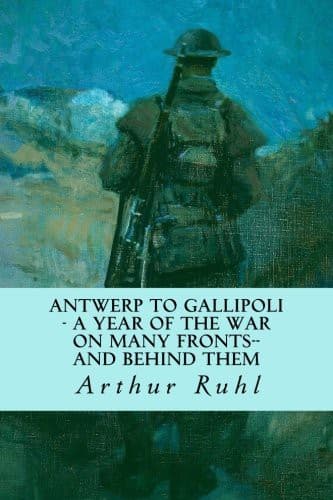
Antwerp to Gallipoli: A Year of the War on Many Fronts—and Behind ThemRuhl, Arthur
History
Antwerp to Gallipoli: A Year of the War on Many Fronts—and Behind Them
Ruhl, Arthur
World War, 1914-1918 -- Personal narratives
We crossed into Hungary, rolled northeastward for five or six hours into
the Vag valley, with its green hills and vineyards and ruined castles,
and finally came to a little place consisting almost entirely of
consonants, in the Tatra foot-hills. Two blond soldiers in blue-gray
saluted, took my luggage, showed me to a carriage, and drove to a
village about a mile away--a little white village with a factory chimney
for the new days, a dingy chateau for the old, and a brook running
diagonally across the square, with geese quacking in it and women
pounding clothes.
It was mid-afternoon, yet lunch had been kept waiting, and the officer
who received me said he was sorry I had bothered to eat on the train. He
told me where lodgings had been made ready, and that an orderly would
take me there and look after my personal needs. They dined at eight,
and at five, if I felt like it, I would probably find some of them in
the coffee-house by the chateau. Meanwhile the first thing to do was to
take one's cholera vaccination--for no one could go to the Galician
front without being geimpft--and just as soon as I could take the
second, a week later, we should start for the Russian front. In this
fashion were strangers welcomed to the "Presse-Quartier," or rather to
that part of it--this little Hungarian village--in which correspondents
lived during the intervals of their trips to the front. The Austrians
have pleasant manners. Their court is, next to that of Spain, the most
formal in Europe, and ordinary life still retains many of the older
courtesies. Every time I came into my hotel in Vienna the two little
boys at the door jumped up and extended their caps at arm's length; an
assistant porter, farther in, did the same; the head porter behind the
desk often followed, and occasionally all four executed the manoeuvre at
once, so that it was like a musical comedy but for the music.
The ordinary salutation in Vienna, as common as our "hello!" is "I have
the honor" (Ich habe die Ehre!). In Hungary--of course one mustn't tell
a Hungarian that he is "Austrian"--people tell you that they are your
humble servants before they say good morning, and those who really are
humble servants not only say "Kiss the hands," but every now and then do
it. It was natural, therefore, perhaps, that the Austro-Hungarians
should treat war correspondents--often, in these days, supposed to be
extinct--not only seriously but with a certain air. They had not only
the air but indeed a more elaborate organization than any of the other
belligerents.
At the beginning of the war England permitted no correspondents at all
at the front. France was less rigid, yet it was months before groups of
observers began to be taken to the trenches.
Public-domain text, read in full here on John Shaqi.
Reviews
Reviews
No reviews yet
Be the first to share your thoughts on this work.
Elsewhere in the archive
Join the Discussion
Join the discussion
Sign in to leave a comment or review.
Sign InorCreate an account