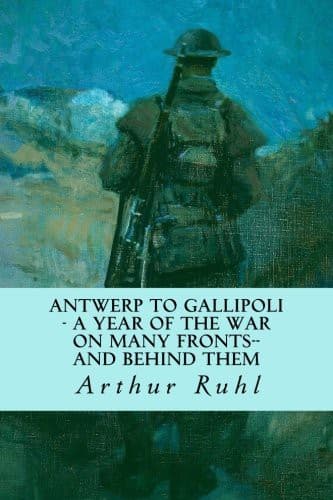
Antwerp to Gallipoli: A Year of the War on Many Fronts—and Behind ThemRuhl, Arthur
History
Antwerp to Gallipoli: A Year of the War on Many Fronts—and Behind Them
Ruhl, Arthur
World War, 1914-1918 -- Personal narratives
Germany took correspondents to the front from the first, but these
excursions came at irregular intervals, and admission to them involved a
good deal of competitive wire-pulling between the correspondents
themselves. The Austro-Hungarians, on the other hand, prepared from the
first for a large number of civilian observers, including news and
special writers, photographers, illustrators, and painters, and, to
handle them satisfactorily, organized a special department of the army,
this Presse-Quartier, once admitted to which--the fakirs and
fly-by-nights were supposed to be weeded out by the preliminary red tape
--they were assumed to be serious workmen and treated as the army's
guests.
The Presse-Quartier was divided into two sections: an executive section,
with a commandant responsible for the arrangement of trips to the
various fronts, and the general business of censorship and publicity;
and an entertainment section, so to speak, also with its commandant,
whose business it was to board, lodge, and otherwise look after
correspondents when they were not on trips to the front. At the time I
visited the Presse-Quartier, the executive section was in Teschen; the
correspondents lived in Nagybiesce, two or three hours' railroad journey
away.
It was to this village--the most novel part of the scheme--that I had
come that afternoon, and here some thirty or forty correspondents were
living, writing past adventures, setting forth on new ones, or merely
inviting their souls for the moment under a regime which combined the
functions of tourists' bureau, rest-cure, and a sort of military club.
For the time being they were part of the army--fed, lodged, and
transported at the army's expense, and unable to leave without formal
military permission. They were supposed to "enlist for the whole war,"
so to speak, and most of the Austro-Hungarian and German correspondents
had so remained--some had even written books there--but observers from
neutral countries were permitted to leave when they felt they had seen
enough.
Isolated thus in the country, the only mail the military field post, the
only telegrams those that passed the military censor, correspondents
were as "safe" as in Siberia. They, on the other hand, had the
advantage of an established position, of living inexpensively in
pleasant surroundings, where their relations with the censor and the
army were less those of policemen and of suspicious character than of
host and guest. To be welcomed here, after the usual fretful dangling
and wire-pulling in War Office anterooms and city hotels--with hills and
ruined castles to walk to, a brook rippling under one's bedroom window,
and all the time in the world--seemed idyllic enough.
Public-domain text, read in full here on John Shaqi.
Reviews
Reviews
No reviews yet
Be the first to share your thoughts on this work.
Elsewhere in the archive
Join the Discussion
Join the discussion
Sign in to leave a comment or review.
Sign InorCreate an account