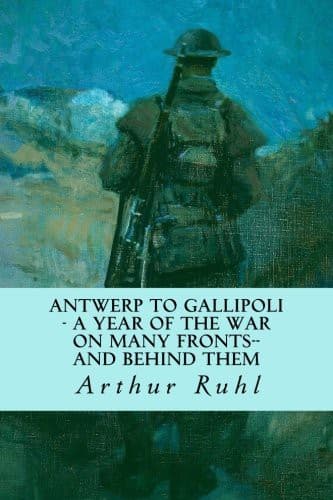
Antwerp to Gallipoli: A Year of the War on Many Fronts—and Behind ThemRuhl, Arthur
History
Antwerp to Gallipoli: A Year of the War on Many Fronts—and Behind Them
Ruhl, Arthur
World War, 1914-1918 -- Personal narratives
How many people who talk or write about war would have the courage to
face a minute, fractional part of the reality underlying war's inherited
romance? People speak with pleasant excitement of "flashing sabres"
without the remotest thought of what flashing sabres do. A sabre does
not stop in mid-air with its flashing, where a Meissonier or a Detaille
would paint it--it goes right on through the cords and veins of a man's
neck. Sabre wounds are not very common, but there was one in the Vienna
hospital that morning--a V-shaped trench in which you could have laid
four fingers fiat, down through the hair and into the back of the man's
neck, so close to the big blood-vessel that you could see it beat under
its film of tissue--the only thing between him and death. I thought of
it a day or two later when I was reading a book about the Austrian army
officer's life, written by an English lady, and came across the phrase:
'"Sharpen sabres!' was the joyful cry."
Be joyful if you can, when you know what war is, and, knowing it, know
also that it is the only way to do your necessary work. The absurd and
disgusting thing is the ignorance and cowardice of those who can
slaughter an army corps every day for lunch, with words, and would not
be able to make so trivial a start toward the "crushing" they are
forever talking about as to fire into another man's open eyes or jam a
bayonet into a single man's stomach. Among the Utopian steps which one
would most gladly support would be an attempt to send the editors and
politicians of all belligerent countries to serve a week in the enemy's
hospitals.
Chapter XV
East Of Lemberg--Through Austria-Hungary to the Galician Front
We left Nagybiesce in the evening, climbed that night through the high
Tatras, stopped in the morning at Kaschau long enough for coffee and a
sight of the old cathedral, rolled on down through the country of robber
barons' castles and Tokay wine, and came at length, in the evening, to
Munkacs and the foot of the high Carpathians.
This was close to the southernmost point the Russians touched when they
came pouring down through the Carpathian passes, and one of the places
in the long line where Germans and Austro-Hungarians joined forces in
the spring to drive them back again. Munkacs is where the painter
Munkacsy came from. It was down to Munkacs, through Silesia and the
Tatras, that the troop-trains came in April while snow was still deep in
the Carpathians. Now it was a feeding-station for fresh troops going up
and wounded and prisoners coming down.
Public-domain text, read in full here on John Shaqi.
Reviews
Reviews
No reviews yet
Be the first to share your thoughts on this work.
Elsewhere in the archive
Join the Discussion
Join the discussion
Sign in to leave a comment or review.
Sign InorCreate an account