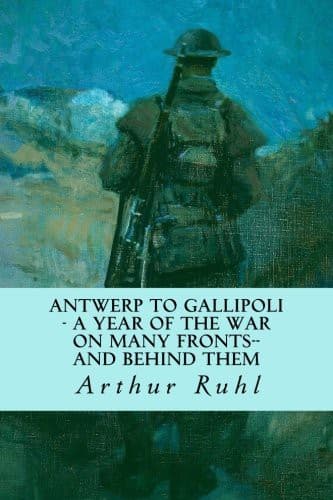
Antwerp to Gallipoli: A Year of the War on Many Fronts—and Behind ThemRuhl, Arthur
History
Antwerp to Gallipoli: A Year of the War on Many Fronts—and Behind Them
Ruhl, Arthur
World War, 1914-1918 -- Personal narratives
The officers in charge had no notion we were coming, but no sooner heard
we were strangers in Hungary than we must come in, not only to dinner,
but to dine with them at their table. We had red-hot stuffed paprika
pods, Liptauer cheese mixed salmon-pink with paprika, and these and
other things washed down with beer and cataracts of hospitable talk.
Some one whispering that a bit of cheese might come in handy in the
breakfastless, cholera-infested country, into which we were going that
night, they insisted we must take, not merely a slice, but a chunk as
big as a small trunk. We looked at the soup-kitchen, where they could
feed two thousand a day, and tasted the soup. We saw the
dressing-station and a few wounded waiting there, and all on such a
breeze of talk and eloquent explanation that you might have thought you
had stepped back into a century when suspicion and worry and nerves were
unknown.
The Hungarians are like that--along with their indolence and romantic
melancholy--lively and hospitable and credulous with strangers. Nearly
all of them are good talkers and by sheer fervor and conviction can make
almost any phrase resemble an idea and a real idea as good as a play.
Hungarians are useful when trenches must be taken by storm, just as the
sober Tyrolean mountaineers are better for sharp-shooting and slow
resistance.
One of the interesting things about the Austro-Hungarian army, as well,
of course, as an inevitable weakness, is the variety of races and
temperaments hidden under these blue-gray uniforms--Hungarians,
Austrians, Croatians, Slovaks, Czechs. Things in universal use, like
post-cards and paper money, often have their words printed in nine
languages, and an Austro-Hungarian officer may have to know three or
four in order to give the necessary orders to his men. And his men
cannot fight for the fatherland as the Germans do; they must rally round
a more or less abstract idea of nationality. And one of the surprises
of the war, doubtless, to many people, has been that its strain, instead
of disintegrating, appears to have beaten this loose mass together.
Public-domain text, read in full here on John Shaqi.
Reviews
Reviews
No reviews yet
Be the first to share your thoughts on this work.
Elsewhere in the archive
Join the Discussion
Join the discussion
Sign in to leave a comment or review.
Sign InorCreate an account