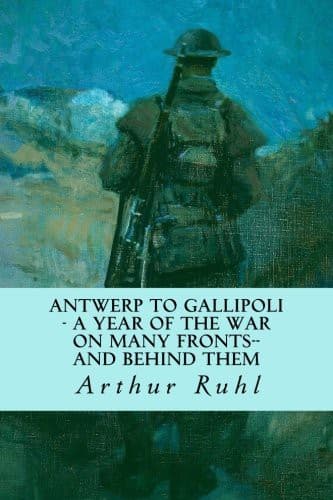
Antwerp to Gallipoli: A Year of the War on Many Fronts—and Behind ThemRuhl, Arthur
History
Antwerp to Gallipoli: A Year of the War on Many Fronts—and Behind Them
Ruhl, Arthur
World War, 1914-1918 -- Personal narratives
We lunched with a corps commander and dined with a genial old colonel
and his staff, and between times motored through level farming country
to a position to the northward on the Rata, a tributary of the Bug.
Both sides were watching each other here from their sausage-shaped
captive balloons, and a few aeroplanes were snooping about but at the
moment all was quiet. The Austro-Hungarians had been waiting here for
over a fortnight, and the artillery-men had polished up their battery
positions as artillery-men like to do when they have time. Two were in
a pasture, so neatly roofed over with sod that a birdman might fly over
the place until the cows came home without knowing guns were there.
Another, hidden just within the shadow of a pine forest, was as
attractive as some rich man's mountain camp, the gun positions as snug
as yacht cabins, the officer's lodges made of fresh, sweet-smelling pine
logs, and in a little recess in the trees a shrine had been built to St.
Barbara, who looks out for artillery-men.
The infantry trenches along the river, cut in the clean sand and neatly
timbered and loopholed, were like model trenches on some exposition
ground. Through these loopholes one could see the Russian trenches,
perhaps a mile away, and in between the peasant women, bright red and
white splashes in the yellow wheat, were calmly going ahead with their
harvest. All along the Galician front we saw peasants working thus and
regarding this elaborate game of war very much apparently as busy
farmers regard a draghunt or a party of city fishermen. At one point we
had to come out in the open and cross a foot-bridge. "Please--
Lieutenant," one of the soldiers protested as the officer with us
stepped out, standing erect, "it is not safe!" The officer crouched and
hurried across and so did we, but just before we did so, up out of the
field where they had been mowing, straight through this gap, came a
little company of barefooted peasant women with their bundles of
gleanings on their heads, and talking in that singsong monotone of
theirs, as detached as so many birds, they went pat-patting across the
bridge. If one of these women could but write her impressions of war!
They had done their part, these peasant women and old men and children.
All over Galicia, round the burned villages, right through barbed-wire
entanglements up to the very trenches, stretched the yellow wheat.
Somehow they had ploughed and sowed and brought it to harvest, and now
with scythes, with knives even, sometimes, they were getting it under
cover. At home we know gleaners generally only in rather sentimental
pictures; here we saw them day after day, barefooted women and children
going over the stubble and picking up the forgotten wheat heads and
arranging them in one hand as if they were a bouquet. There will be no
wheat wasted this year.
Public-domain text, read in full here on John Shaqi.
Reviews
Reviews
No reviews yet
Be the first to share your thoughts on this work.
Elsewhere in the archive
Join the Discussion
Join the discussion
Sign in to leave a comment or review.
Sign InorCreate an account