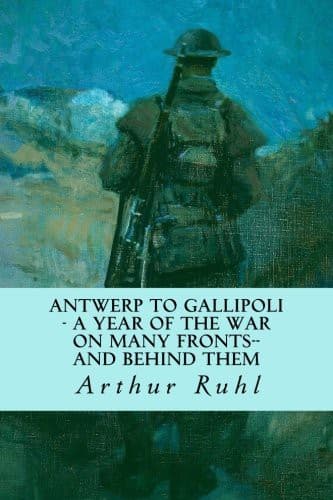
Antwerp to Gallipoli: A Year of the War on Many Fronts—and Behind ThemRuhl, Arthur
History
Antwerp to Gallipoli: A Year of the War on Many Fronts—and Behind Them
Ruhl, Arthur
World War, 1914-1918 -- Personal narratives
And with them everywhere were the Russian prisoners, swinging scythes,
binding grain, sometimes coming down the road, without even a guard,
sprawled in the sun on a load of straw. It would be hard to find a
place where war seemed more a vast theatricalism than in some of these
Hungarian and Galician neighborhoods. There seemed to be no enmity
whatever between captors and prisoners. Everywhere the latter were
making themselves useful in the fields, in road-making, about railroad
yards, and several officers told me that it was surprising how many good
artisans, carpenters, iron-workers, and so on, there were among them.
The Russians got exactly the same food as the Hungarian soldiers, and
were paid a few cents a day for their work. You would see men in the
two uniforms hobnobbing in the open freight-cars as the work-trains
rolled up the line, and sometimes a score or so of husky Russians
working in the wheat, guarded by some miniature, lone, Landsturm man. Of
all the various war victims I had seen, these struck me as the most
lucky--they could not even, like the wounded, be sent back again.
We drove back through the dark that night, and in the bright, waving
circle of an automobile search-light, with the cool breath from the
pines in our faces, saw that long "front" roll back again. Now and then
a soldier would step into the white circle and, holding up his arm,
struggle between his awe of this snorting motor with its imperial
double-eagle flag and its sharp-voiced officers muffled in gray coats--
between his peasant's habit of taking off his hat and letting such
people blow by, and his soldier's orders to stop every-thing that
passed. He stopped us, nevertheless, and the pass was laboriously read
in the light of his electric lamp before we went on again.
In the dark and quiet all the countless joints and wheels of the vast
organism were still mysteriously turning. Once, in a cloud of dust, we
passed troops marching toward the front--tired faces, laughing faces--
the shout "Man in the road !" and then the glimpse of a couple of Red
Cross men kneeling by a soldier who had given out on the way; once, in
the black pines, cows driven by two little frightened peasant children;
once a long line of bearded Jews, bound, with packs on their backs, for
what was left of their homes; a supply-train, a clanking battery, and
now and then other motors like ours with shrouded gray figures,
streaking by in a flashing mist of dust.
Next day, swinging southward into another sector of the front, over
beautiful rolling hills, rather like the Genesee Valley, we drummed up a
hill and came out at the top in a village square. It had once been a
white little village clinging to the skirts of an old chateau--the
village of Swirz and Count Lavasan's chateau--and both were now black
and tumbled walls.
Public-domain text, read in full here on John Shaqi.
Reviews
Reviews
No reviews yet
Be the first to share your thoughts on this work.
Elsewhere in the archive
Join the Discussion
Join the discussion
Sign in to leave a comment or review.
Sign InorCreate an account