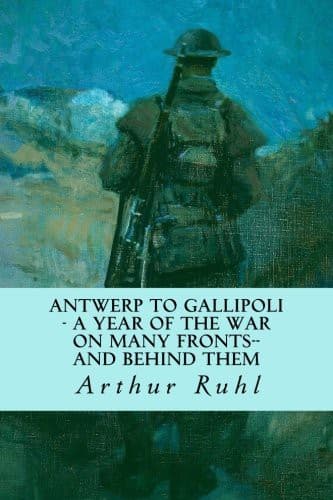
Antwerp to Gallipoli: A Year of the War on Many Fronts—and Behind ThemRuhl, Arthur
History
Antwerp to Gallipoli: A Year of the War on Many Fronts—and Behind Them
Ruhl, Arthur
World War, 1914-1918 -- Personal narratives
In the centre of the square people were singing--a strange little crowd
and strange, mournful singing. We thought at first it was a funeral
service, for the women were weeping as they sang, but as the auto-mobile
swept up beside them, we saw that it was men the women were crowding
round--live men, going away to war.
They were men who had not been called out because the Russians held the
country, and by one of fate's ironies, now that the enemy had been
beaten and driven home, they must go out and fight. At a little table
by the side of the square sat the recruiting officer with his pen and
ledger, and the village school-master, a grave, intelligent-looking
young man, who must have held such a place in this half-feudal village
as he would have done a hundred years ago, was doing his best to glamour
over the very realistic loss of these wives and sweethearts with
patriotism's romance. He sang and obediently they all wailed after him
the old song of scattered Poland--"Poland is not lost" "Yeszcze Polska
me Zginela Poki my zygemy..."
The song stopped, there was a word of command, and the little squad
started away. The women clung to their men and cried aloud. The
children hanging to their skirts began to wail, too. There was
something creepy and horrible, like the cries of tortured animals, in
that uncontrolled crying there in the bright morning sunshine. The
schoolmaster spoke to them bluntly, told them to go back to their homes
and their work, and obedient, and a little quieter now, they drifted
away, with aprons to their faces and their little children clinging to
their skirts--back to their cottages and the winter ahead.
This picture did not fit in very well with our rollicking military
panorama, but we were soon over the hills, and half an hour later were
breakfasting on pate-de-foie-gras sandwiches and champagne, with a
charming old corps commandant, at a round table set outdoors in a circle
of trees that must have been planted for that very purpose. Cheered and
stiffened by many bows and heel clickings and warming hospitality, we
hurried off to an artillery position near the village of Olszanica.
Just under the brow of a hill we were stopped and told that it was
dangerous to go farther, and we skirted off to the right under cover, to
the observation station itself. More little Swiss chalets, more
hospitable officers, and out in front, across a mile of open country,
the Russian trenches. Through a periscope one could see Russians
exercising their horses by riding them round the circle--as silent and
remote and of another world as a picture on a biograph screen.
Public-domain text, read in full here on John Shaqi.
Reviews
Reviews
No reviews yet
Be the first to share your thoughts on this work.
Elsewhere in the archive
Join the Discussion
Join the discussion
Sign in to leave a comment or review.
Sign InorCreate an account